Register or Login to Hide This Ad for Free!
Status
Not open for further replies.
Just asked an industry friend about this and he said Eddy current brakes need a non-magnetic but conductive metal to work, so it's either copper or aluminum. The older Intamin mega coasters like the Superman coasters at SFA, SFDL and SFNE, and Millennium Force use aluminum brakes on the side of the trains.
Yes, that’s how they work. My question was why Intamin still uses both LSM Stators and copper brake fins on their launches when LSM stators act the same when turned off (basically a bunch of copper inside there, acting as a bare copper fin). The only guess I have to it is if stators are not needed over the whole launch track for acceleration, but they need to slow the train down in case of emergency, so they have the brakes.
 
  • Like
Reactions: Unagi
Just asked an industry friend about this and he said Eddy current brakes need a non-magnetic but conductive metal to work, so it's either copper or aluminum. The older Intamin mega coasters like the Superman coasters at SFA, SFDL and SFNE, and Millennium Force use aluminum brakes on the side of the trains.
Yep.

The late-90s era Premier trains had separate conductive fins for launch (on both sides of train) and braking (on the underside of train). I always found that interesting. A good choice, given the amount of heat that gets dumped into eddy current brake fins. Also a good choice given that by design, these rides placed primary launch LIMs and permanent magnet brakes on the same stretch of the track, so they had to geometrically coexist...

Anyway, it's a bit different when you carry your permanent magnet with you on the train, a la LSM.
 
Yes, that’s how they work. My question was why Intamin still uses both LSM Stators and copper brake fins on their launches when LSM stators act the same when turned off (basically a bunch of copper inside there, acting as a bare copper fin). The only guess I have to it is if stators are not needed over the whole launch track for acceleration, but they need to slow the train down in case of emergency, so they have the brakes.
Or if they perceive the need to slow the train much more quickly (in an anomalous event) than that stretch of LSM stators can manage alone.

In the event that the switch fails to reset, the train coming down from 2/3 up the top hat would need to come to a complete stop well before reaching the switch... are the inert stators sufficient to remove enough kinetic energy to do that, guaranteed? The train rolls into them at launch time with an initial ~25 mph speed, and all of that energy plus everything the stators dump into the train during that first pass needs to be bled off completely... in a shorter distance than the first pass launch, so (I presume) a holding brake can then soak up that final little crawl of speed and bring the train to a complete and secure stop on its own. And on top of that, there's surely a substantial factor of safety in the braking design, too...
 
@ControlsEE , I'm not engineer but I drove by a Holiday Inn Express a few days ago... So science coaster question(s).

Sheesh I start to type and someone answers my question... So another-

What happens in a power failure should a train need to e-stop heading backwards toward the spike? I'd think a generator would take too long to power up. Thank you. I'll hang up and listen to your answer.

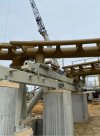
While I'm here- side shot of the switch track -

Screenshot_20200123-181147_Chrome.jpg
 
Or if they perceive the need to slow the train much more quickly (in an anomalous event) than that stretch of LSM stators can manage alone.

In the event that the switch fails to reset, the train coming down from 2/3 up the top hat would need to come to a complete stop well before reaching the switch... are the inert stators sufficient to remove enough kinetic energy to do that, guaranteed? The train rolls into them at launch time with an initial ~25 mph speed, and all of that energy plus everything the stators dump into the train during that first pass needs to be bled off completely... in a shorter distance than the first pass launch, so (I presume) a holding brake can then soak up that final little crawl of speed and bring the train to a complete and secure stop on its own. And on top of that, there's surely a substantial factor of safety in the braking design, too...
My thoughts exactly. In engineering, there is always a safety factor. Sometimes a 1.25 or 1.75 factor works. This may be a 2-3 safety factor.
 
Last edited:
  • Like
Reactions: Unagi and halfabee
@ControlsEE , I'm not engineer but I drove by a Holiday Inn Express a few days ago... So science coaster question(s).

Sheesh I start to type and someone answers my question... So another-

What happens in a power failure should a train need to e-stop heading backwards toward the spike? I'd think a generator would take too long to power up. Thank you. I'll hang up and listen to your answer.

While I'm here- side shot of the switch track -

View attachment 19413
That’s what the brake fins are for. They are spring and air driven (spring up and air down) so that they will pop up instantaneously. From there, it takes no electricity to stop the train, just electromagnetics. The LSM stators also act as brake fins when turned off. Also, a system like this would have a Uninterruptible Power Supply (just like you can get for your computer) to keep the most vital components (Safety PLC for instance) running.
 
Last edited:
I read someone’s guess before that because the track switch is so quick, maybe the ride can wait until the switch is locked before actually accelerating the coaster further. Not sure if that’ll be the case, but it sounds plausible.
 
I read someone’s guess before that because the track switch is so quick, maybe the ride can wait until the switch is locked before actually accelerating the coaster further. Not sure if that’ll be the case, but it sounds plausible.
If it’s programmable, it’s plausible ?
 
  • Like
Reactions: DC High Heat
Yep.

The late-90s era Premier trains had separate conductive fins for launch (on both sides of train) and braking (on the underside of train). I always found that interesting. A good choice, given the amount of heat that gets dumped into eddy current brake fins. Also a good choice given that by design, these rides placed primary launch LIMs and permanent magnet brakes on the same stretch of the track, so they had to geometrically coexist...

Anyway, it's a bit different when you carry your permanent magnet with you on the train, a la LSM.

It should be noted that both FoF and Backlot primarily use friction air brakes and not eddy current brakes. Backlot has a couple sets of eddy current brakes, but they are more like trims and aren’t used to hold the train. Volcano had sets of hydraulic friction brakes (they loved to overheat in the summer) that were used to hold the train in place at the end of blocks. Intimidator and Twisted use eddy current brakes as their only source of braking and use drive tires to hold trains in place.
 
It should be noted that both FoF and Backlot primarily used friction air brakes and not eddy current brakes.
Yeah, I was using "late 90s" to limit it to Batman, Robin, Mr. Freeze 1, and Mr. Freeze 2.

Though Mad Cobra, Joker's Jinx, and Poltergeist were all in the second half of the 90s, and didn't use eddy currents for primary braking. Oh well.
 
80s dispatch interval is a theoretical of 900. I did not hear 720 on the tour video, just the park president saying "something like 800".
 
80s dispatch interval is a theoretical of 900. I did not hear 720 on the tour video, just the park president saying "something like 800".

How do you reach 900? I'd like to see your math.

With an 80 second dispatch, that's a max of 45 dispatches per hour (60/1.333333)

45 trains times 16 (train capacity) = 720.

So, I don't agree with 900.


*Edit I think I know where 900 came from.

150 second ride time times two cars would add to something over 900 per hour. But that would require a 55 second dispatch to achieve.

But with an 80 second dispatch time you can never hit that.

So the capacity is 720.
 
Last edited:
80s dispatch interval is a theoretical of 900. I did not hear 720 on the tour video, just the park president saying "something like 800".
Yeah, the ACE video I linked here said "very similar to Apollo, in the 8 range... Something like 800".

He mentioned the switch track "only in China and Florida" so obviously he's only talking Intamin switches.

Also it bugs me he's bragged about 3 launches..."one right out of the station" and then two after the switch. I guess he isn't up to speed after being gone.
 
Also it bugs me he's bragged about 3 launches..."one right out of the station" and then two after the switch. I guess he isn't up to speed after being gone.

So, I noticed this in the video and I think I figured it out.

It's "launch sections" vs "launches".

There is the initial launch, and then the switch area seems to be comprised of two separate lsm chains.

So there are three sets of LSM launches. Even though there are more transits through the launches.

So that's to say both figures are correct.
 
Status
Not open for further replies.
Consider Donating to Hide This Ad