Register or Login to Hide This Ad for Free!
This could (eventually: 10-20 years down the road, not short term) be a deadly blow to KD. Without ANY room to expand they'll landlock themselves to a Disneyland level. They'll HAVE to replace things, when they currently have so much room for expansion. Plus the sound/smell of data centers will not do well to the park. I'm afraid this could be a park-ending decision eventually. Not to mention what it'll do to the water park with Kalahari opening.
Terrible, TERRIBLE choice by 6F. But I guess when you're tens-of-millions-in-debt you do what you gotta do
 
I think the fear of losing expansion land is far overblown - though I do believe it would have been better to move the BoH facilities south and improve the parking lot and front gate areas, there's still plenty of infill expansion areas the park clearly hasn't had much interest in using when capex funding becomes available.

Perhaps it could also be a blessing in disguise if the county routed new roads into the property that just so happens to allow KD to relatively cheaply build an independent Soak City gate due to the reduced infrastructure requirements.

I do otherwise agree that it will constrict the park, but mostly on BoH logistics since they're selling off land that contains their private service routes which may make transporting things and/or maintenance responses without going through guest areas more difficult (BGW mostly solved this issue with bridges over their service roads).

Even in the best of economic times, I don't see park management wanting to do much more than fill in and/or replace existing water park attractions - the money maker is the dry park.
 
This could (eventually: 10-20 years down the road, not short term) be a deadly blow to KD.
As much as I disagree with this move, primarily with the western parcel eating into potential water park land, I think this is a pretty dramatic over exaggeration of the state of things. KD will still have a healthy amount of expansion land especially with the pretty massive Dino's + Raceway + XSF plot of land. The other big point here is that parks will remove attractions over time no matter what. We will 100% see more land open up within the park in that 20 year time frame. The main negative impact this has is it essentially eliminates any future of a widespread soak city rework in the much more modern southside and cements the awkward north south split as well as the outdated infrastructure of northside.
 
Perhaps it could also be a blessing in disguise if the county routed new roads into the property that just so happens to allow KD to relatively cheaply build an independent Soak City gate due to the reduced infrastructure requirements.
The only way this works is with some kind of shuttle van or bus from the existing parking lot (park up front and then wait for a bus to avoid the walk through the park). That seems unlikely to me. They are losing all the land that could have been parking for a hypothetical Soak City gate by selling off this land.
 
The only way this works is with some kind of shuttle van or bus from the existing parking lot (park up front and then wait for a bus to avoid the walk through the park). That seems unlikely to me. They are losing all the land that could have been parking for a hypothetical Soak City gate by selling off this land.

Maybe I'm not looking at the boundaries correctly, but it looks like there's space to the west of the park not going up for sale.

The parking lot doesn't need to be huge up front; it could be phased to meet demand. Of course, that's highly dependent on any existing expansion plans and what may happen if/when the land is sold.
 
  • Like
Reactions: AmyUD06
This could (eventually: 10-20 years down the road, not short term) be a deadly blow to KD. Without ANY room to expand they'll landlock themselves to a Disneyland level. They'll HAVE to replace things, when they currently have so much room for expansion. Plus the sound/smell of data centers will not do well to the park. I'm afraid this could be a park-ending decision eventually. Not to mention what it'll do to the water park with Kalahari opening.
Terrible, TERRIBLE choice by 6F. But I guess when you're tens-of-millions-in-debt you do what you gotta do

Just curious what you think data centers smell or sound like? Because when a data center is on normal power it's a quiet static building. The only times a data center have substantial sound or smell is when running on generator power and if that's the case that means the park is closed because power is out. Yes, the gensets will cycle periodically for maintenance but they stagger those so you wouldn't hear more than one or two running and they have pretty good sound enclosures around them nowadays.
 
Just curious what you think data centers smell or sound like? Because when a data center is on normal power it's a quiet static building. The only times a data center have substantial sound or smell is when running on generator power and if that's the case that means the park is closed because power is out. Yes, the gensets will cycle periodically for maintenance but they stagger those so you wouldn't hear more than one or two running and they have pretty good sound enclosures around them nowadays.
To view this content we will need your consent to set third party cookies.
For more detailed information, see our cookies page.

Direct Link to Embedded Media Source
To view this content we will need your consent to set third party cookies.
For more detailed information, see our cookies page.

Direct Link to Embedded Media Source
 
While I wouldn't want a data center near my house, it certainly isn't for noise or smell. They belong in industrial areas just like manufacturing or warehousing - mere proximity to them is going to negatively affect property values.

In most NoVa neighborhoods, the air traffic overhead or highways nearby is louder than anything heard there from a data center. The difference in annoyance is that the data center noise is fairly constant in both volume and frequency distribution.

I'm confident that a data center right next to KD would not be audible from inside the park. The east side of the park is very close to I-95, but has anyone noticed the noise or smell from that while inside the park? Parks are inherently loud themselves with noise from rides, people, background music, etc. Just take a look at these numbers: USF.edu Thesis: Noise Exposures for Amusement Park Employees or Institue of Noise Control Engineering: Noise from Amusement Park Attractions. The sound levels sighted for parks in these studies are significantly higher than what would be measured from neighboring data centers.
 
While I wouldn't want a data center near my house, it certainly isn't for noise or smell. They belong in industrial areas just like manufacturing or warehousing - mere proximity to them is going to negatively affect property values.

In most NoVa neighborhoods, the air traffic overhead or highways nearby is louder than anything heard there from a data center. The difference in annoyance is that the data center noise is fairly constant in both volume and frequency distribution.

I'm confident that a data center right next to KD would not be audible from inside the park. The east side of the park is very close to I-95, but has anyone noticed the noise or smell from that while inside the park? Parks are inherently loud themselves with noise from rides, people, background music, etc. Just take a look at these numbers: USF.edu Thesis: Noise Exposures for Amusement Park Employees or Institue of Noise Control Engineering: Noise from Amusement Park Attractions. The sound levels sighted for parks in these studies are significantly higher than what would be measured from neighboring data centers.
Agreed. I'm generally in the "I think we've got enough in VA already" camp, but next to KD is probably one of the smarter places to put one. They just need to plaster the roof with solar panels. I'm not sure why that isn't a mandatory requirement.
 
I'm going to stand by my statement here:

Data centers being near KD would negatively impact the experience.

Between the environmental impacts, sound impacts, pollution; it's all going to have a massive impact. Especially with how close and how much of a buffer exists between the park and the data centers.

In regards to sound, most data centers give off an average decibel reading in the upper 90's. I saw someone bring up I95, and highway is mid-70's at 50 feet away. The noise decreases 3-4 decibels every time the distance doubles, so by the time it hits rides it's travelled ~700 feet and pathways ~1200 feet. So at the rides you are talking about 55-65 dB's, which is average dB's of a conversation. At the path it's low 50's, which is about the same as typical residential background noise.

If the data center is to the east and there's minimal sound blockage you are talking if it's just across the train tracks and it's about 800 feet away it would come into the park around 70 dB's, which would be like heavy traffic. With more setback at 1000 ft it would be upper' 60's dB's which is like constant traffic in front of your house. If it goes south of SC, accounting for average tree density you are talking upper 70's dB's if i's about 300 feet away, which is like actively vacuuming. And if it's 500 feet away it would be lower 70's dB's which would be like standing near the highway in the first example.

Now, the issue with dB's in a park is they aren't consistent. Being near a ride can have spikes of up to 100 dB's (level of a lawnmower) or get into the low 60's when walking around. OSHA has regulations of maxing time at those levels over 85 dB's which is part of the reasons for breaks and movement. The issue would come into adding to the sound level. All the base level readings would go up, which impacts the exposure limits.

Now the other part of noise that you need to consider is the frequency not just the decibel level. A park tends to give off mid & high frequencies which travel in singular directions (ie the dB's of screams from Pantherian are louder if you faced the drop vs in the queue) and tend to fade much faster. There's also the psychological impact that high frequency noise tends to be energizing to the human mind.

Comparatively data centers give off a much lower frequency noise that is no omni-directional, so it tends to move further, penetrate barriers easier, and tends to be more harmful on the human psyche. This is typically the sounds that bother people more and tends to lead to complaints.

Now there's the more than just the to people impact of the sounds. It effects animals too as data has shown the wildlife tends to migrate away from data centers because of the effect the noise pollution has on them. So there would move many of them away, but even more so there's the service animals that some people might need. They would be significantly impacted by the continual low frequency sound given off by the data centers.

I saw someone bring up the solar and helping with power; just a quick reference point on that, the typical 60 MW data center would need 1,200-1,680 ACRES of solar to power on solar alone. That's 3-4x the size of KD itself. So without adding anything that can produce that power it's still going to significantly impact the power grid overall.

And you can go down the line into water impacts on the greater community and how that can impact SC, the traffic impact of Data Center employees now needing those local roads, and even future development impacts since more people would be working there that may not want to commute super far which brings in more traffic, more congestion, ect to the area.
 
In regards to sound, most data centers give off an average decibel reading in the upper 90's.
Measured at what distance? Without knowing that, the data is pointless. If you watch the CBS news video that @coasters_bgw posted above (the second video), the highest measurement they could get "right along side the data center" was 68db. That's immensely quieter than upper 90s, and they were out to find the highest reading they could.
 
Measured at what distance? Without knowing that, the data is pointless. If you watch the CBS news video that @coasters_bgw posted above (the second video), the highest measurement they could get "right along side the data center" was 68db. That's immensely quieter than upper 90s, and they were out to find the highest reading they could.
Not to mention that it'll be at a noisy amusement park filled with people, loud mechanical sounds, and constant atmospheric audio/music blasting from the speakers.
 
Measured at what distance? Without knowing that, the data is pointless. If you watch the CBS news video that @coasters_bgw posted above (the second video), the highest measurement they could get "right along side the data center" was 68db. That's immensely quieter than upper 90s, and they were out to find the highest reading they could.
Standard measuring is 10m outside the source. (per a cousin-in-law that's a sound engineer) I watched the video, and the problem that I see is it's a one time stop by of a facility and looks like they are further than the 10m. I've sent the video to me cousin-in-law for his thoughts and he hasn't come back with his thoughts yet. Something to keep in mind is what's the time of year that the data was captured. Cooling needs in Fall/Winter are much different than cooling needs in the summer with high humidity which would impact the sound output.

But as I pointed out the frequency matters just as much as the dB level. Even at a low dB level, a lower frequency comes across to the human ear much worse than a high frequency sound at a higher dB level.
 
Last edited:
Even at a low dB level, a lower frequency comes across to the human ear much worse than a high frequency sound at a higher dB level.
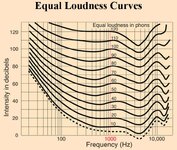
Actually, the human ear is much more sensitive at higher frequencies. For example, to create a sound at 20Hz that has a perceived volume that matches a 65db sound at 500Hz, it would require almost 110db. And this disparity is even greater at lower volumes as can be seen in the Robinson-Dadson curves below. The difference is even more if you use the ISO226 Standard.

RD Curves.jpg
 
  • Dislike
Reactions: warfelg
@MisterToro my reference wasn't about damage, I was referring there to the way most people perceive the frequency. The prolonged low frequency exposure psychologically is more harmful.

Effectively my stance here with the sound is using dB's alone can easily make the noise issue disposable. When you combine the effects of frequency, decibel, and distance, a data center creates more noise pollution and a more disturbing noise pollution than many other noise pollution centers.

At this point I can only give my own personal antidote of having a friend that I absolutely cannot visit for more than an hour. He lives a 1/4 mile from a data center and every time I'm there too long I get a migraine that my neurologist as attributed to the frequency and decibel of the data center. I get the same migraine every time I fly and go to concerts. Yet I don't get it when I'm at amusement parks because even though the decibels are higher, the frequency being higher doesn't trigger the same response in my brain.

My neurologist has said in many people with multiple concussions like myself they have observed an extremely similar outcome of low frequency items at a decibel level above standard room noise creates significant problems. If KD gets a data center on the land right next to where it exists, I unfortunately know it's going to be a park I can no longer visit due to this issue.
 
Last edited:
  • Dislike
Reactions: MisterToro
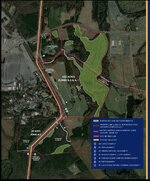
thanks for the screenshot, @guy305. What about the parcel north of the power lines and due south of the water park, @G-Starr? That was the part I think most of us were most concerned with; the other parcels are further away and already have solid boundaries that make them highly unlikely for the park to use for anything other than what they were originally purchased for - a buffer zone from future development.
 
  • Like
Reactions: Mike541x
That's my biggest concern, too. Any type of expansion for Soak City seems to be gone if that area between the power lines and the park is sold. Isn't that part of the park currently used by maintenance as well?
 
Consider Donating to Hide This Ad