
COVID-19’s Impacts on BGW
- Thread starter WDWRLD
- Start date
You are using an out of date browser. It may not display this or other websites correctly.
You should upgrade or use an alternative browser.
You should upgrade or use an alternative browser.
Register or Login to Hide This Ad for Free!
I agree I don’t see our governor budging one bit and this could last until next summer you see everyone now canceling football for this falllooks like we can fork any chance of bgw this year, cases on the rise...

The Trump administration's own Coronavirus Taskforce rules say that additional waves of restriction reductions should not occur while test positivity percentages are increasing. So yeah, I'd hope that our governor doesn't "budge" right now—it would be in direct contradiction with the White House's officially-stated reopening America policies.
According to the president's guidelines, VA will need fourteen days of continual percentage-positive declines before any additional restriction reductions can be considered.
According to the president's guidelines, VA will need fourteen days of continual percentage-positive declines before any additional restriction reductions can be considered.

Yep and way Virginia is going now it can’t go 14 hours much less days!The Trump administration's own Coronavirus Taskforce rules say that additional waves of restriction reductions should not occur while test positivity percentages are increasing. So yeah, I'd hope that our governor doesn't "budge" right now—it would be in direct contradiction with the White House's officially-stated reopening America policies.
According to the president's guidelines, VA will need fourteen days of continual percentage-positive declines before any additional restriction reductions can be considered.

Honestly, with cases in VA increasing, I’m a little glad Northam didn’t allow the parks to open, so the parks can’t be blamed for the rising cases.

Saw this story from Henrico about the Virginia-wide task forces coming together to discuss amusements/events strategies, which involved Lembke: https://www.henricocitizen.com/articles/getting-back-into-action/
Relevant section beyond the parts you should already know (1000 person limit, not feasible) as you get a sense of the park's current position:
Seems like this particular committee isn't advocating pushing back on the Governor's restrictions, but he's continuing to push the idea that "IAAPA has developed these guidelines and they're working elsewhere and we can't stay closed indefinitely so we're ready when you are." But obviously, the data isn't even supporting the state remaining at Phase 3 right now, so I highly doubt they'll get a green light anytime soon.
Relevant section beyond the parts you should already know (1000 person limit, not feasible) as you get a sense of the park's current position:
Although the committee’s proposals did not work in Lembke’s favor, he was adamant to point out the positives of the collaborative effort by the group as well as the efforts of the United States amusement park’s governing body, the International Association of Amusement Parks and Attractions. Much like Virginia’s committee, Lembke has been collaborating with competitors who have put aside their egos and agendas in order to figure out how to reopen.
“That’s brought a lot of consistency to each of the parks approaches,” Lembke explained. “What you see at Universal is very similar to what you see at Busch Gardens in Tampa, our sister park. I was able to travel down to Tampa about two weeks ago and I was there for their opening to see everything and in person. You learn constantly that things change constantly… But it’s been a very good, consistent experience.
“The feedback continues to get better and better from the guest saying we have a good balance of safety measures. And at the same time, I still feel like I can have fun. At the end of day, it is still an amusement park or a theme park. Collaboration amongst industry leaders, I would say is unparalleled. I’ve been in the industry now 20 years and I can’t remember a time where all of those groups were on the same calls and really sharing details like that again. We do collaborate, but not at that level.”
Seems like this particular committee isn't advocating pushing back on the Governor's restrictions, but he's continuing to push the idea that "IAAPA has developed these guidelines and they're working elsewhere and we can't stay closed indefinitely so we're ready when you are." But obviously, the data isn't even supporting the state remaining at Phase 3 right now, so I highly doubt they'll get a green light anytime soon.
Nothing particularly newsworthy in the latest local story focused on the closure's impact on tourism in the area, although I did find this part interesting:
Initially it had seemed like Lembke was going to be active in lobbying the state, but it feels like the park realizes that such efforts would read very differently in a situation where the state is back up to averaging 1000 cases a day, compared to the 600 or so when the Phase 3 restrictions were first revealed.
Park officials had created a potential plan for reopening that would allow for 5,000 to 7,000 guests to enter the park. Attempts were made to reach out to Busch Gardens for an update on their plans of operation, but a representative was not immediately available to comment.
Initially it had seemed like Lembke was going to be active in lobbying the state, but it feels like the park realizes that such efforts would read very differently in a situation where the state is back up to averaging 1000 cases a day, compared to the 600 or so when the Phase 3 restrictions were first revealed.

Nothing particularly newsworthy in the latest local story focused on the closure's impact on tourism in the area, although I did find this part interesting:
Initially it had seemed like Lembke was going to be active in lobbying the state, but it feels like the park realizes that such efforts would read very differently in a situation where the state is back up to averaging 1000 cases a day, compared to the 600 or so when the Phase 3 restrictions were first revealed.
That data is subjective though. Back when those guidelines were released Virginia was averaging 9,000 test per a day according to the Virginia Department of health data. Today we are averaging around 14,000 with spikes on some days bringing us up to as high as just under 17,000 on a couple of days. we gone from a weekly average of 6.4% to a weekly average of 7.3% again according to the Virginia Department of health site. So in other words the data supports the actual infection rate barely rising in that time. Also relevant data when those guidelines were released the Department of health was reporting 34 hospital admissions a week on average for Covid as of last it's it's an average of 27. The average deaths for a week 7 as of last week 4.8. I am not sure that I see anything in that data that would make an argument for not fighting that 1,000 person cap.

Its all a numbers game, they are saying that ICU beds are full or 75% full....but what they arent saying is thatnow compared to before they are doing surgeries and some of those beds are tied up from those.
While that’s an argument for discontinuing elective surgeries in some of these places again, the exact reason an ICU bed is filled when it’s needed for COVID doesn’t actually matter—if they’re out of beds, they’re out of beds.
We EXPECT a certain number of beds to be occupied at any given time—we lack the surge capacity to deal with COVID outbreaks—that’s a core part of the issue here.
We EXPECT a certain number of beds to be occupied at any given time—we lack the surge capacity to deal with COVID outbreaks—that’s a core part of the issue here.
That data is subjective though. Back when those guidelines were released Virginia was averaging 9,000 test per a day according to the Virginia Department of health data. Today we are averaging around 14,000 with spikes on some days bringing us up to as high as just under 17,000 on a couple of days. we gone from a weekly average of 6.4% to a weekly average of 7.3% again according to the Virginia Department of health site. So in other words the data supports the actual infection rate barely rising in that time. Also relevant data when those guidelines were released the Department of health was reporting 34 hospital admissions a week on average for Covid as of last it's it's an average of 27. The average deaths for a week 7 as of last week 4.8. I am not sure that I see anything in that data that would make an argument for not fighting that 1,000 person cap.
Data is not subjective. Data is open to interpretation. Which is to say that while there are multiple ways to interpret data, they are not all equal: there are wrong ways of interpreting data.
The numbers clearly communicate that we are heading in the wrong direction in terms of containing the virus. Yes, because the rise in new cases is primarily driven by younger individuals, the hospitalization and death rates have not been rising at the same rate. But the rise in less serious/asymptomatic cases is honestly an even greater concern, as it creates a far greater likelihood of people not realizing they have the virus and unknowingly infecting others who ARE higher risk, which will start to be reflected as the current surge of cases plays out. And while you're right that the statewide levels aren't seeing dramatic shifts, cases locally in Hampton Roads (a key market for the park) have exploded, with the positive rate at 10% or above across the entire region, and closer to 15% in Norfolk and Virginia Beach.
For all of these reasons, cherry-picking specific data points that keep us from entering Florida/Arizona/Texas territory doesn't work as an argument for the park trying to push against the state's decision, because there is no interpretation of the larger set of data points that suggests the virus is more under control now than it was a month ago when the Phase 3 decision was made.

I'm not sure how anyone could look at the numbers over the past few months and draw any reasonable conclusion from them based on how they were developed. Recorded cases are much higher now in absolute terms, but testing is also far greater. Is the actual infection rate among the population higher or lower than a few months ago, there's really no reasonable way to tell since you don't have common testing standards to baseline the time series data against. Serology studies are one way to try and guess at a baseline, but they vary quite a bit and get interference from other coronaviruses. You could maybe look at death rates, but even that changes as the overall operating environment has changed - i.e. wide open to self policing to shutdown to opening phases - that at best you'd be making serious assumptions in a data model that would add pretty wide control limits to any honest analysis.
None of that will stop the continued cherry picking of data and trend lines to support whatever opinion is being pushed, for or against a policy.
None of that will stop the continued cherry picking of data and trend lines to support whatever opinion is being pushed, for or against a policy.
I'm not sure how anyone could look at the numbers over the past few months and draw any reasonable conclusion from them based on how they were developed. Recorded cases are much higher now in absolute terms, but testing is also far greater. Is the actual infection rate among the population higher or lower than a few months ago, there's really no reasonable way to tell since you don't have common testing standards to baseline the time series data against. Serology studies are one way to try and guess at a baseline, but they vary quite a bit and get interference from other coronaviruses. You could maybe look at death rates, but even that changes as the overall operating environment has changed - i.e. wide open to self policing to shutdown to opening phases - that at best you'd be making serious assumptions in a data model that would add pretty wide control limits to any honest analysis.
None of that will stop the continued cherry picking of data and trend lines to support whatever opinion is being pushed, for or against a policy.
I’m sorry, but this “we just don’t know!” stance is ridiculous in my opinion.
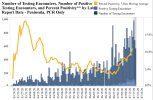
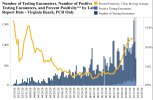
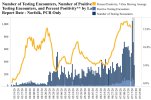
Prerequisites for testing in VA—namely symptom and exposure requirements—have become FAR laxer (which should LOWER the positivity percentages) but, instead, positivity percentages have INCREASED. Any suggestion that this isn’t indicative of a rise in cases overall is patently absurd.
Last edited:
Quantify this. Until you can do that you may as well put +/-20% or more on anything produced.I’m sorry, but this “we just don’t know!” stance is ridiculous in my opinion.
Prerequisites for testing in VA—namely symptom and exposure requirements—have become FAR laxer (which should LOWER the positivity percentages) but, instead, positivity percentages have INCREASED. Any suggestion that this isn’t indicative of a rise in cases overall is patently absurd.
No one is saying we know how many cases there actually are exactly—no one knows that—we are, reasonably, stating that we can follow the trend line in the data though.
You’re only looking at the number of recorded cases in your analysis, but those aren’t based on the same standards, they are based on how many tests were given which has changed drastically . To compare apples to apples you would have to make assumptions based on testing standards to normalize out prior months data to today’s data. At best those assumptions are going to have pretty wide variability, so figuring out if the actual number of cases (the number no one knows or could know) has gone down or up is at best a guess.
You’re only looking at the number of recorded cases in your analysis
False. We are talking about the percent-positive number—ignoring the total number of positive tests entirely. This is the only sane way to look at the data. Everyone knows positives will increase as testing increases—the RATIO of positive to negative results should be DECREASING though as testing requirements relax—instead the opposite is happening
Last edited:

You’re only looking at the number of recorded cases in your analysis, but those aren’t based on the same standards, they are based on how many tests were given which has changed drastically . To compare apples to apples you would have to make assumptions based on testing standards to normalize out prior months data to today’s data. At best those assumptions are going to have pretty wide variability, so figuring out if the actual number of cases (the number no one knows or could know) has gone down or up is at best a guess.
I don't think this is intended to say that there isn't a problem, because obviously there is. I'm interpreting this as more that it's impossible to tell to what degree there's a problem no matter what sort of visualization is put on it because there's no existing model out there that allows for a level playing field to compare data over time, so the best we have is going by the trend of a potentially flawed measurement.
To @Zachary's point, it's a percentage measurement and not totals. However, I question what that percentage is comprised of - wouldn't the same uncertainty @rswashdc is claiming exists for totals also affect any further calculations, averages included, derived from such totals?

I think an interesting datapoint that seems to get lost is the problem of false negatives.
Just today my doctor told me that not only is the rate of false negatives high, but apparently it is higher in people who are asymptomatic. In fact, she said that they prefer not to test people who aren’t showing any symptoms and instead ask them to self-quarantine.
Just today my doctor told me that not only is the rate of false negatives high, but apparently it is higher in people who are asymptomatic. In fact, she said that they prefer not to test people who aren’t showing any symptoms and instead ask them to self-quarantine.
However, I question what that percentage is comprised of - wouldn't the same uncertainty @rswashdc is claiming exists for totals also affect any further calculations, averages included, derived from such totals?
Sure. There are uncontrolled variables throughout. No one is talking about trying to draw conclusions from any specific day or even a few days—that’s why the trend line is the 7 day average—it smooths over the inevitable inconsistencies from day to day.
No one is trying to use this data to pinpoint an exact number of cases—but I think any reasonable, unbiased actor would look at the consistent rise in the 7 day rolling average and reasonably conclude with a high degree of confidence that SOMETHING started to change at the end of June in VA. Since that change can’t be attributed to something like tighter testing requirements (they’ve been relaxed) or fewer tests being conducted overall (rationing tests to only the most needy)—I don’t see how anyone could possibly not interpret the data as an indication of a likely overall increase in cases in VA.
Trying to concoct some elaborate alternative justification for the very significant spike in the 7 day rolling average without any actual data to back it up just strains credulity frankly.
Share:
Consider Donating to Hide This Ad