
News Cedar Fair Merges with Six Flags
- Thread starter horsesboy
- Start date
You are using an out of date browser. It may not display this or other websites correctly.
You should upgrade or use an alternative browser.
You should upgrade or use an alternative browser.
Register or Login to Hide This Ad for Free!

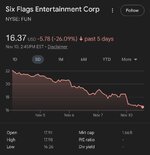


Was there anything in the investor meeting that would cause this? Like, are the shareholders upset at the prospect of them closing more parks or something?Stock is down 10% todayView attachment 40331
Most likely. It's not like they are getting rid of money losers. They were talking about getting rid of parks that don't make enough profits. Companies are not usually in the business of getting rid of profit centers.Like, are the shareholders upset at the prospect of them closing more parks or something?

Might have something to do with this…
Lawsuit: Six Flags misled investors about park conditions before merger with Cedar Fair
Lawsuit: Six Flags misled investors about park conditions before merger with Cedar Fair
If you ask me. They will likely first get out of all those long term leases for those smaller parks (Darien Lake, Frontier City) & the standalone waterparks except for White Water Atlanta. Maybe they keep around Hurricane Harbor Concord cause DK doesn’t have a waterpark.Most likely. It's not like they are getting rid of money losers. They were talking about getting rid of parks that don't make enough profits. Companies are not usually in the business of getting rid of profit centers.
After that, the parks I could see being on the chopping block (excluding CGA) are
Six Flags St. Louis
Michigan’s Adventure
La Ronde
The Great Escape
Potentially parks like Valleyfair & Dorney (although I see Dorney being sold off rather than closed)


A class action lawsuit has been file by investors alleging that Six Flags mislead them prior to the completion of the merger on the condition of the parks to help push the merger along

 www.cleveland.com
Lawsuit: Six Flags misled investors about park conditions before merger with Cedar Fair
The lawsuit alleges Six Flags touted "transformational investments" while actually deferring repairs and cutting staff before the 2024 merger with Cedar Fair, the former parent company of Cedar Point.
www.cleveland.com

Typically security prospectus are super heavily caveated, but outright misrepresentation is possible. Who knows if this lawsuit has any legs, but some of the management decisions post merger (e.g. tearing out a sizable portion of GAdv) wouldn't surprise me if underlying issues were masked or falsified in legacy SF.

That’s not true at all. Companies spin off or divest profitable assets all the time. It allows concentration of strategy and capital on the company’s core business, and they get the upfront cash flow from the sale of whatever business they’ve divested. The profitability of the divested business will be baked into the sale price.Companies are not usually in the business of getting rid of profit centers.
I imagine the investors are spooked by the atrocious third quarter results in general. Selling more parks strikes me as a strategy designed to help turn those results around, not the cause of the problems.
The stock is down and will not recover because this company has no plan for growth. Stocks that increase our companies that have growth plans. This company is trying to avoid bankruptcy by potentially selling off properties. Even if they sell those properties, there is no potential for growth.
Plus, their management style has proved that they cannot grow revenue. It’s a very bad investment.
I would never rule Carowinds as being off the list to be sold. The land is very valuable, surrounded by warehouses, and the park gets a mediocre attendance at best.
Plus, their management style has proved that they cannot grow revenue. It’s a very bad investment.
I would never rule Carowinds as being off the list to be sold. The land is very valuable, surrounded by warehouses, and the park gets a mediocre attendance at best.
I get what you are saying there @Mushroom but what was floated was the closure of parks. It would seem very different if they talked about spinning off non-core assets like water park only, but what they floated was closing parks that didn't meet an unknown threshold. If you want to scare shareholders as much as possible, you create uncertainty. That statement reeks of it.
And I'm sorry/not sorry on this, but it's time to really sound the alarms around SF.Tthis merger was a bad idea at the time and is getting worse as time passes.
And I'm sorry/not sorry on this, but it's time to really sound the alarms around SF.Tthis merger was a bad idea at the time and is getting worse as time passes.

I'm curious with the squeezing of the economy in general by the current incompetent regime funneling ever more from those with nothing and the middle class to the oligarchs if even under the best management this chain was going to have some bad financial outcomes?
This industry relies heavily on two things: overseas support (manufacturers, in-park labor) and there being enough people with enough money to spend some of their discretional budgets on their parks (passes, parking, food/beverage, shops, etc.) in exchange for a valuable experience.
Let's see - input costs going up on top of an already heavily leveraged corporation whose portfolio of assets has continued to shrink in value before adding in the new sets of issues of a populace that has less and less discretionary budget who also generally perceives the legacy parks as providing an average experience at best.
Selling these parks may help pay down some of that debt, but given everything else I don't see how they can get out of their problems in general.
This industry relies heavily on two things: overseas support (manufacturers, in-park labor) and there being enough people with enough money to spend some of their discretional budgets on their parks (passes, parking, food/beverage, shops, etc.) in exchange for a valuable experience.
Let's see - input costs going up on top of an already heavily leveraged corporation whose portfolio of assets has continued to shrink in value before adding in the new sets of issues of a populace that has less and less discretionary budget who also generally perceives the legacy parks as providing an average experience at best.
Selling these parks may help pay down some of that debt, but given everything else I don't see how they can get out of their problems in general.
I don’t agree. I’m an investor in FUN (maybe you are too), and I think focus and immediate cash flow are exactly what this company needs to get back on track. I don’t expect them to name the exact parks because that would introduce all sorts of premature PR nightmares, and I don’t expect them to give the exact metric of what defines “underperforming” because it’s likely a convoluted combination of factors (growth prospects, market size, value of land, investment needed, etc.) that can’t easily be transferred from park to park.I get what you are saying there @Mushroom but what was floated was the closure of parks. It would seem very different if they talked about spinning off non-core assets like water park only, but what they floated was closing parks that didn't meet an unknown threshold. If you want to scare shareholders as much as possible, you create uncertainty. That statement reeks of it.
Speaking as an investor (and not an enthusiast), I absolutely want them to cut out all the non-core parks so they can stop wasting their time and focus on fringe properties, get a quick infusion of cash from the sale of those properties, and focus on making those major properties more profitable.
I have a lot of doubts about how Six Flags is running its parks right now, but I actually think the core strategy of focusing on their premier parks is sound.
Last edited:
I’m an investor too and have been advised to drop fast due to company uncertainty of what and when restructuring will happen.I don’t agree. I’m an investor in FUN (maybe you are too), and I think focus is exactly and immediate cash flow are exactly what this company needs to get back on track. I don’t expect them to name the exact parks because that would introduce all sorts of premature PR nightmares, and I don’t expect them to give the exact metric of what defines “underperforming” because it’s likely a convoluted combination of factors (growth prospects, market size, value of land, investment needed, etc.) that can’t easily be transferred from park to park.
Speaking as an investor (and not an enthusiast), I absolutely want them to cut out all the non-core parks so they can stop wasting their time and focus on fringe properties, get a quick infusion of cash from the sale of those properties, and focus on making those major properties more profitable.
I have a lot of doubts about how Six Flags is running its parks right now, but I actually think the core strategy of focusing on their premier parks is sound.
Now that, I agree with. This stock is a rock.I’m an investor too and have been advised to drop fast due to company uncertainty of what and when restructuring will happen.
Maybe this is our chance to see if the stock drops a lot lower and finally launch our ParkFans hostile takeover bid of Six Flags.

Something to consider is the underperforming parks may have little to no actual market value in a potential sale beyond the underlying real estate value. If they've got millions in deferred maintenance, rides nearing the end of their service life, and a limited revenue/profit market, there aren't going to be many buyers interested in that. It's going to be hard selling/spinning off parks that need $50-100M+ in investment each just to tread water - a'la SFA.I get what you are saying there @Mushroom but what was floated was the closure of parks. It would seem very different if they talked about spinning off non-core assets like water park only, but what they floated was closing parks that didn't meet an unknown threshold. If you want to scare shareholders as much as possible, you create uncertainty. That statement reeks of it.
And I'm sorry/not sorry on this, but it's time to really sound the alarms around SF.Tthis merger was a bad idea at the time and is getting worse as time passes.
Yea. My advisor is the one that said the statement of closing parks that don’t meet an unspecified profit line is the red flag. He said usually they would have a metric to point to, or can show it’s a money suck in some way (my words not his), or show some indication to know the direction.Now that, I agree with. This stock is a rock.
Maybe this is our chance to see if the stock drops a lot lower and finally launch our ParkFans hostile takeover bid of Six Flags.
Sure. But the counter argument is are they underperforming because of the issues you laid out. With proper investments they may not just tread water but succeed. We will never know with SFA.Something to consider is the underperforming parks may have little to no actual market value in a potential sale beyond the underlying real estate value. If they've got millions in deferred maintenance, rides nearing the end of their service life, and a limited revenue/profit market, there aren't going to be many buyers interested in that. It's going to be hard selling/spinning off parks that need $50-100M+ in investment each just to tread water - a'la SFA.
People much smarter than likely many of us are the ones looking into this stuff but sometimes the short term win of selling the land isn’t as fruitful as the long term gains from transforming the property.
Like just think if they do everything to prep the land for sale at SFA, then they find out there’s now environmental cleanup because of the park, and the cost of removing everything, the potential case there is they broke even with the sale of the land, especially if the county hardliners the zoning (devaluing the land) which has a strong chance (old neighbor works in the county) of happening.
End of the day, something seems really off and fishy with they way things were laid out in the call and the lawsuit that’s coming up.

Sure. But the counter argument is are they underperforming because of the issues you laid out. With proper investments they may not just tread water but succeed. We will never know with SFA.
They are underperforming because of the previously referenced issues. Everyone agrees with that. With proper investments, most, if not all, of the parks in the chain's portfolio could become good, healthy parks. But that's not the issue at all.
People much smarter than likely many of us are the ones looking into this stuff but sometimes the short term win of selling the land isn’t as fruitful as the long term gains from transforming the property.
But again, literally no one is arguing this. Obviously the long-term gains of transforming these properties would be more fruitful, but that option isn't actually on the table. It's not possible. There are too many assets in need of reinvention and there's nowhere near enough time and money to tackle all of them. In order to actually execute overhauls for the assets that are likely to generate the most value to shareholders long-term, the investment opportunities must be pared down.
Yea. My advisor is the one that said the statement of closing parks that don’t meet an unspecified profit line is the red flag. He said usually they would have a metric to point to, or can show it’s a money suck in some way (my words not his), or show some indication to know the direction.
That would make sense if they chain were offloading poorly performing assets to stabilize the company, but that isn't the play. They're offloading potentially valuable, moderately performing assets with relatively higher investment requirements, relatively longer runways to success, and/or relatively low ceilings of potential success in order to stabilize the company and execute turnaround strategies at other properties.
The chain isn't looking at a balance sheet and saying "these are the parks with total profits lower than X so we're closing them." The chain is evaluating the potential success the parks in their portfolio could reasonably achieve, estimating what it would take to get that property there, doing a market evaluation to determine the likely current value of the asset if sold, highlighting the parks with the least optimistic forecasts that could provide capital if sold, and then deciding on a bespoke path forward for each. They're not giving investors precise criteria because it's in large part an art, not a mathematical equation.
Like just think if they do everything to prep the land for sale at SFA, then they find out there’s now environmental cleanup because of the park, and the cost of removing everything, the potential case there is they broke even with the sale of the land, especially if the county hardliners the zoning (devaluing the land) which has a strong chance (old neighbor works in the county) of happening.
It's way too early to say how the SFA land sale is going to go down, but it's not our only case study. CGA's land was already sold and I have yet to see anyone argue that that deal wasn't GREAT for the corporation.
I obviously think this merger was a horrible idea. I've been shouting that from the rooftops for years at this point. Given the performance of the combined company, I think most everyone agrees with that position now.
That said, now that Cedar Fair has elected to tie themselves to the giant lead weight that was legacy Six Flags and they've suffered enormously as a result, I don't see why the current plan as laid out by Six Flags, isn't just the right option, but probably the only remotely viable option to right the ship.
Last edited:
I was t trying to argue anything. Just add my own commentary to it.But again, literally no one is arguing this. Obviously the long-term gains of transforming these properties would be more fruitful, but that option isn't actually on the table. It's not possible. There are too many assets in need of reinvention and there's nowhere near enough time and money to tackle all of them. In order to actually execute overhauls the ones the assets that are likely to generate the most value to shareholders long-term, the investment opportunities must be pared down.
6 in one, half a dozen in another is the way I read this. Sorry. I feel like we’re saying the same thing in really different ways.That would make sense if they chain were offloading poorly performing assets to stabilize the company, but that isn't the play. They're offloading potentially valuable, moderately performing assets with relatively higher investment requirements, relatively longer runways to success, and/or relatively low ceilings of potential success.
The chain isn't looking at a balance sheet and saying "these are the parks with total profits lower than X so we're closing them." The chain is evaluating the potential future success parks in their portfolio could reasonably achieve, estimating what it would take to get that property there, doing a market evaluation to determine the likely current value of the asset if sold, and then picking the parks with the least optimistic forecasts to consider shuttering with the goal of actually enacting the turnaround plans at the properties with more optimistic forecasts.
As for the bolded this is from their own call:
Either the goal is to perform like a top park or move out from it. The uncertainty is what do they consider the best perks performance wise?roadmap for the underperforming parks centers on two primary pathways: migrating those parks toward the performance profile of our best parks within the portfolio, or classifying them as non-core and divesting them where it makes strategic and financial sense
Agreed it’s too early and the CGA sale worked. But I brought up the great unknown of just saying the selling the land of parks is the right answer every time. Just because the land under a park could be valuable means it would be every time.It's way too early to say how the SFA land sale is going to go down, but it's not our only case study. CGA's land was already sold and I have yet to see anyone argue that that deal wasn't GREAT for the corporation.
Just because it might be the only option forward and viable, doesn’t mean people need to like it.I obviously think this merger was a horrible idea. I've been shouting that from the rooftops for years at this point. Given the performance of the combined company, I think most everyone agrees with that position now.
That said, now that Cedar Fair has elected to tie themselves to the giant lead weight that was legacy Six Flags and they've suffered enormously as a result, I don't see why the current plan as laid out by Six Flags, isn't just the right option, but probably the only remotely viable option to right the ship.
I think the issue I take is SF was tanking, CF was surging. On the surface it kinda made sense. Then shareholders were sold on a plan to have CF executives lead a company names SF. Which gave confidence for people to vote yes (me included to be transparent). But then it’s doing the same things SF was doing pre-merger. That’s the bigger issue I take.
Share:
Consider Donating to Hide This Ad