
If you ask me I would say the extra moving parts are probably the big concern. If something goes wrong on one side you're stuck running one train ops instead of the desired two trains with this setup. Yeah the flip side is that if something goes wrong then the entire ride goes down but less moving parts = less chance of failure. I have a feeling the amount of time and money needed for Mack to design that station setup for one ride was just not worth it for Six Flags in the end (especially with the increased risk of being at half capacity). I have a feeling lines might be really bad at first because you're likely to have a brand new crew of ride ops but hopefully as the season goes on they can consistently get the loading train ready to go before the other train gets back to the station. I have a lot more faith in this working out at great adventure than I would any of the United Parks. I visited BGT last week and then came back to Great Adv for the preview and the difference in operations was night and day. In the grand scheme of things ops is one of the things that Great Adv has always done a really good job with.
News Project 2027/Purple: Delayed “World Record Breaking Coaster" (Phantom Spire?)
- Thread starter Zachary
- Start date
You are using an out of date browser. It may not display this or other websites correctly.
You should upgrade or use an alternative browser.
You should upgrade or use an alternative browser.
Register or Login to Hide This Ad for Free!


I have so many thoughts.
This is a problem that faces all of the world's single-station coasters. On most dual-station attractions, this is NOT an issue. Mack has sold SFGAdv one of the few dual-platform setups that DOESN'T mitigate this issue. That's worthy of significant criticism in my opinion.
Yes, that addresses one possible incident that can delay a load/unload cycle but there are many, many, MANY others that will cause delays. I have some examples in my earlier post, but there's a near-infinite number even if you completely remove loose articles from the equation.
You have a far higher tolerance for lines than I. I contemplated suicide watching some of the worst operations I've ever seen at a park during my visit last fall. There are always good crews and bad crews, average crews having good days and bad days, unique issues plaguing specific crews or specific rides on specific days—whatever—you get it. I'm not condemning the crews. Parks don't pay enough for them to care. It's a nearly-industry-wide-issue.
THAT SAID, EXACTLY BECAUSE we live in a world of mediocre-to-bad ride operations, parks and manufacturers should be designing rides to aggressively mitigate that however possible—particularly when you're designing a new flagship coaster for a major park serving some of the largest metro areas in the entire country.
To have not done that is abominable in my opinion.
I can grant you all of this. I believe the costs and R&D (especially given the coaster's delay) would have been VERY well worth it, but even if I accept that it wasn't, that brings us to this question:
For which I refuse to accept these justifications. The park had all the space they wanted. The site is HUGE, the property is HUGE, there were ZERO space constraints when designing this thing. We already know the track layout was changed vs the off-the-shelf model for SFGAdv because of the addition of the slight turn to keep the tower near the Ka tower site. There's absolutely no way in hell it wasn't feasible to use a simple Y-switch with two independent platforms. Given how prevalent Y-switches are on coasters (and frankly how common dual platform Y-switch coasters are), we have absolutely zero reason to believe that setup is more expensive than what Mack designed here. In fact, given how few conjoined-track sliding stations exist, I think there's probably a good cost/operations reason we don't see them more—almost certainly because Y-switch setups fall somewhere like this in the options list:
Assuming this analysis is correct (very open to counters!), for a park with no real estate constraints, you would NEVER pick a non-independent sliding track setup and yet, that is what Mack/SFGAdv has implemented here.
But what are those restraints in this situation? I'm so baffled by this. It's a wide open, flat, plot of dirt.
You're just super wrong here. This industry is routinely braindead. Many years ago I used to make this mistake. I would assume malice or deliberate neglect in questions that can be explained by stupidity and disinterest. In this industry, I've learned it's almost always the latter—particularly on the buying-side of the equation. Many parks don't really know what they're buying, don't even have the knowledge required to ask substitutive questions of the manufacturer, don't understand any of the details of whatever is going in, and, in the case of these chain parks, park-level concerns like operations may not even be taken into account at all. Even at parks that seem to be on the more-competent-than-average side of the chart, you would be flabbergasted to hear some of the stories I've heard.
Every bit of this can be explained by ignorance and ineptitude on the buying side and "cost optimization" on the seller-side.
Must be nice. Waited over an hour to be assigned the middle of the train. I try to be the nicest, most friendly guest staff members encounter in a day and there was absolutely zero wiggle-room to negotiate with the grouper at Flash. Luckily it was Flash and I didn't care THAT much. If I'm forcibly assigned rows at Great Adventure's 2027 coaster, I'll be pretty livid though.
Sure, but all of this is an argument for an even cheaper, even more simple Y-switch, yeah?
I sincerely hope this as well, but if history has taught me anything, it's that these chain parks don't care about the speed of their crews and in a few years time, once the absolute best, most passionate ops have been pulled to some other, flashy new ride, we'll be left banging our heads against a wall watching incompetent operations slow this thing to a crawl.
Addressing guest illness - this problem plagues almost every other coaster out there. Someone gets sick, ride shuts down. Yes it could be addressed if they did a sliding station, but it's not really a serious issue considering this is a problem 99% of coasters in the world have
This is a problem that faces all of the world's single-station coasters. On most dual-station attractions, this is NOT an issue. Mack has sold SFGAdv one of the few dual-platform setups that DOESN'T mitigate this issue. That's worthy of significant criticism in my opinion.
Addressing loose articles - GAdv has a pretty strict no loose articles policy. Just have metal detectors and free lockers under the station. Problem solved.
Yes, that addresses one possible incident that can delay a load/unload cycle but there are many, many, MANY others that will cause delays. I have some examples in my earlier post, but there's a near-infinite number even if you completely remove loose articles from the equation.
That leads to dispatch windows - I've never had any major issues with GAdv and their operations on 90% of my visits. I've had a few stints where the ops took a bit longer to check on some of the park's supporting coasters, but the ops at Nitro, Toro, Devil, KK and Flash basically rival Knoebels operations most of the time.
You have a far higher tolerance for lines than I. I contemplated suicide watching some of the worst operations I've ever seen at a park during my visit last fall. There are always good crews and bad crews, average crews having good days and bad days, unique issues plaguing specific crews or specific rides on specific days—whatever—you get it. I'm not condemning the crews. Parks don't pay enough for them to care. It's a nearly-industry-wide-issue.
THAT SAID, EXACTLY BECAUSE we live in a world of mediocre-to-bad ride operations, parks and manufacturers should be designing rides to aggressively mitigate that however possible—particularly when you're designing a new flagship coaster for a major park serving some of the largest metro areas in the entire country.
To have not done that is abominable in my opinion.
So why not implement a sliding station like Freeze?
More moving parts? Moving parts are more prone to breakdowns and reliability issues. The park probably isn't as comfortable with a chance that a sliding station may cause downtime in the future
More expensive? There's a good chance it would probably cost the park more to install the sensors and stuff required to do a sliding station vs their current setup
R & D? Perhaps a station setup like that isn't in development. I believe Mack has experimented with switch elements, but not a switch track station yet. If the park needed this coaster sooner, they'd have to go with whatever's already in the catalog
I can grant you all of this. I believe the costs and R&D (especially given the coaster's delay) would have been VERY well worth it, but even if I accept that it wasn't, that brings us to this question:
They could go with a track switch element - something more tried and true, but what if there isn't enough space to add that? What if extending the launch track just adds more to the cost that the park cannot spend?
For which I refuse to accept these justifications. The park had all the space they wanted. The site is HUGE, the property is HUGE, there were ZERO space constraints when designing this thing. We already know the track layout was changed vs the off-the-shelf model for SFGAdv because of the addition of the slight turn to keep the tower near the Ka tower site. There's absolutely no way in hell it wasn't feasible to use a simple Y-switch with two independent platforms. Given how prevalent Y-switches are on coasters (and frankly how common dual platform Y-switch coasters are), we have absolutely zero reason to believe that setup is more expensive than what Mack designed here. In fact, given how few conjoined-track sliding stations exist, I think there's probably a good cost/operations reason we don't see them more—almost certainly because Y-switch setups fall somewhere like this in the options list:
Cost & Complexity of Implementation:
Y-Switch < Conjoined Sliding Track < Independent Sliding TrackReal-World Capacity Uplift:
Conjoined Sliding Track < Y-Switch < Independent Sliding TrackArea Usage:
Conjoined Sliding Track < Independent Sliding Track < Y-SwitchAssuming this analysis is correct (very open to counters!), for a park with no real estate constraints, you would NEVER pick a non-independent sliding track setup and yet, that is what Mack/SFGAdv has implemented here.
TLDR: the park is just working within the constraints they're given and a sliding station doesn't fit within those constraints. There's probably a good reason why a sliding station had only been implemented on a handful of coasters when there are far more coasters with dual load setups.
But what are those restraints in this situation? I'm so baffled by this. It's a wide open, flat, plot of dirt.
Nah. There's just no way this can be chalked up to ineptitude or lack of funds.
You're just super wrong here. This industry is routinely braindead. Many years ago I used to make this mistake. I would assume malice or deliberate neglect in questions that can be explained by stupidity and disinterest. In this industry, I've learned it's almost always the latter—particularly on the buying-side of the equation. Many parks don't really know what they're buying, don't even have the knowledge required to ask substitutive questions of the manufacturer, don't understand any of the details of whatever is going in, and, in the case of these chain parks, park-level concerns like operations may not even be taken into account at all. Even at parks that seem to be on the more-competent-than-average side of the chart, you would be flabbergasted to hear some of the stories I've heard.
Every bit of this can be explained by ignorance and ineptitude on the buying side and "cost optimization" on the seller-side.
I was allowed to pick my row on Flash when I rode it last year after a two hour wait. You just have to ask nicely. The grouper just must have not liked you. I can't imagine why.
Must be nice. Waited over an hour to be assigned the middle of the train. I try to be the nicest, most friendly guest staff members encounter in a day and there was absolutely zero wiggle-room to negotiate with the grouper at Flash. Luckily it was Flash and I didn't care THAT much. If I'm forcibly assigned rows at Great Adventure's 2027 coaster, I'll be pretty livid though.
If you ask me I would say the extra moving parts are probably the big concern. If something goes wrong on one side you're stuck running one train ops instead of the desired two trains with this setup. Yeah the flip side is that if something goes wrong then the entire ride goes down but less moving parts = less chance of failure. I have a feeling the amount of time and money needed for Mack to design that station setup for one ride was just not worth it for Six Flags in the end (especially with the increased risk of being at half capacity).
Sure, but all of this is an argument for an even cheaper, even more simple Y-switch, yeah?
hopefully as the season goes on they can consistently get the loading train ready to go before the other train gets back to the station.
I sincerely hope this as well, but if history has taught me anything, it's that these chain parks don't care about the speed of their crews and in a few years time, once the absolute best, most passionate ops have been pulled to some other, flashy new ride, we'll be left banging our heads against a wall watching incompetent operations slow this thing to a crawl.
Last edited:

I was allowed to pick my row on Flash when I rode it last year after a two hour wait. You just have to ask nicely. The grouper just must have not liked you. I can't imagine why.
I'll Have You Know I'm Disarmingly Pleasant. But I didn't even ask because I wasn't about to prolong my time in line for Krabby O'Mondays
Last edited:
That's a really fair question, and unless they have something planned in terms of theming for the launch out of the station I don't have answer.Sure, but all of this is an argument for an even cheaper, even more simple Y-switch, yeah?
If the end-all-be-all for the business is making lines as long as possible in order to sell flash passes, why put in the dual station at all? I agree that the current setup isn’t as operationally efficient as the Mr. Freeze style independently sliding stations, but they had every opportunity to just put a single station track.Nah. There's just no way this can be chalked up to ineptitude or lack of funds. I genuinely don't see how you can look at this roller coaster and view it as the best possible experience that the most guests will get the chance to experience for $50 million or whatever. Mr. Freeze opened in 1998, which will be 29 years ago when this opens. The complexity and cost of adding a moving station at all is simply too large to justify NOT investing in whatever in whatever "R&D" costs for independently sliding tracks, a concept almost 3 decades old.
Too much incentive to make the capacity as low as possible, especially with the introduction of "Fast Lane Ultimate." This has ceased to be a business to which the customer pays money for a positive experience. It seems to me the goal is now to make the customer pay money to avoid deliberately-induced negative experiences. I wonder when they'll start introducing Fast Lane Food and upcharged online food ordering. I know there'd be a lot of noise about how that's somehow good for "managing demand" and how "people who don't want it don't have to use it"
Maybe they thought people who missed Kingda Ka would feel placated by a structural allusion to its dual station. Like the BBW drop on Verbolten. A spiritual successor rather than a direct improvement
That's a really fair question, and unless they have something planned in terms of theming for the launch out of the station I don't have answer.
The higher the speed over a Y the tighter the tolerances need to be. Since this ride is launching out of the station, if they had a Y right outside, they'd need tight tolerances or to launch after the Y. Launching after the Y would slow the return speed.
The higher the speed over a Y the tighter the tolerances need to be. Since this ride is launching out of the station, if they had a Y right outside, they'd need tight tolerances or to launch after the Y. Launching after the Y would slow the return speed.
Yep, a Y-switch would slow parking times. Totally agree. That said, I'd be shocked if, on average, in the real-world, the slower parking times would be worse over the course of an average hour than the load/unload delays caused by the lack of flexibility vs a Y-switch.
I do fully agree that the theoretical max capacity of the conjoined sliding setup is slightly higher than the theoretical max capacity of a simple Y-split setup, but a Y-switch copes SO much more effectively with any delays that I believe those theoretical gains are almost certainly wiped out instantly in the real world. And again, I think most parks and manufacturers must agree with me because we have so few examples of a conjoined switch being used but we see Y-switch stations all over the place (even when they require a whole extra switch vs what this shuttle layout would).
I will also say this: I am using the Y-switch as an example in my arguments here, but in my honest opinion, I don't actually believe a Y-switch was an acceptable solution. I don't think anywhere near as many of us would have been anywhere near as lenient of a shuttle coaster replacement of Ka in the first place if a hyper-efficient station setup weren't rumored/understood to be a core part of the concept. I know I wouldn't have been. There are numerous different ways to cleverly design a shuttle coaster station area to boost capacity far beyond that of a Y-switch or even an independent, dual, sliding station setup. Simply asking for a pretty middle-of-the-road, milquetoast design that has been implemented on other, less noteworthy, smaller-market coasters for almost three decades now is a very reasonable demand in my assessment and, since this ride was originally rumored, has been my expectation. I wouldn't have been happy at all to see a Y-switch used here just as I am not at all happy to see a conjoined sliding track setup used here.
In my idea world, Mack would have provided an even more efficient setup than what we were expecting—something with a staging brake on a side track to maximize the likelihood of another train being ready to launch immediately once the shuttle layout clears—something using a full side-track and braking spike setup like was proposed for Drachen Spire to enable two trains to occupy the shuttle area at once—there are tons of creative possibilities out there—a Mr. Freeze-style setup was my bare minimum.
Ultimately, if a park the size of Great Adventure is going to pursue a shuttle coaster, I believe we should hold their feet to the fire and demand that it be VERY aggressively optimized for capacity. I don't know what Six Flags did or did not request from Mack, but I do believe that what Mack has delivered here is simply not a shuttle coaster design aggressively optimized for capacity.
Last edited:
It’s possible it launches from the station and therefore a y switch isn’t possible. I’m sure someone else has mentioned that idk I don’t read half of the time.
That being said, Zachary’s issues with the sliding station setup are definitely valid. Maybe there’s maintenance bays directly behind each side of the station that trains can easily move back to for cleaning/repairs while the other side stays open.
All will be forgiven for me if this station and the launch are enclosed
That being said, Zachary’s issues with the sliding station setup are definitely valid. Maybe there’s maintenance bays directly behind each side of the station that trains can easily move back to for cleaning/repairs while the other side stays open.
All will be forgiven for me if this station and the launch are enclosed

The station and start of the launch out of the station are enclosed. To-be-constructed.It’s possible it launches from the station and therefore a y switch isn’t possible. I’m sure someone else has mentioned that idk I don’t read half of the time.
That being said, Zachary’s issues with the sliding station setup are definitely valid. Maybe there’s maintenance bays directly behind each side of the station that trains can easily move back to for cleaning/repairs while the other side stays open.
All will be forgiven for me if this station and the launch are enclosed
I really hope they theme this coaster well. Could you imagine just for fun, they have a animatronic in the station and a pre show. I would call it a “strata dark ride” lol. But honestly, they really need more immersive theming for new rides. Flash was rumored to have theming inside the enclosed queue and there was nothing at all! I am looking forward to see what they do!The station and start of the launch out of the station are enclosed. To-be-constructed.
Direct Link to Embedded Media Source
They are really flying through this. Look how much progress has been made just since yesterday.
They already put in 4 new A frame supports and installed track.


You know what we know.When are we going to see an announcement??
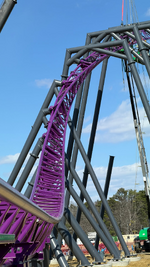 We are now inverted! You can see the first launch track piece staged at the bottom of this picture behind the supports.
Next 2-3 months according to RyanWhen are we going to see an announcement??
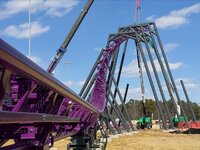
Here’s a better angleView attachment 41775We are now inverted! You can see the first launch track piece staged at the bottom of this picture behind the supports.

I can't say for sure, but all of my sources say no. As far as anyone will tell me, the project was developed as a Kingda Ka replacement. Most people who know are still tight lipped on this subject.Was this supposed to operate along Ka?
Pure speculation on my part; based on the rumors that the ride closed early, I think the construction of this ride was orignially envisioned to start before KK was removed.
Last edited:
I have a strong suspicion that time-range is going to be changed. It's like bottleneck speed they are working at. I mean I feel like 50% of the ride could be built by next week. It perplexes me that they'd have an announcement late like that when it will already be clearly in the air.Next 2-3 months according to Ryan
Share:
Consider Donating to Hide This Ad