Register or Login to Hide This Ad for Free!
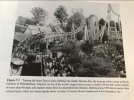
Yes each car did have the red lights and they worked every night on all the trains. It really looked awesome....I really liked that ride and rode it 8-10 times a week. There was never a line in the evening when I would be at the park and you could ride and seat basically a walk on.
 
Man seeing all the structural quirks of the ride from that angle really opens up just how messed up that ride really was. The more of these pictures I see the more amazed I am it even lasted as long as it did.
Some ride engineers I talked with in the 90s (from non-Arrow ride vendors, notably) actually marveled at length about the massive and apparently spectacular welds in DF’s lift hill structure and elsewhere around the ride. They were pretty impressed with the volume of material and the configurations they saw in the ride’s supports, which went above and beyond what they would have specified. (Years later, a couple of younger engineers at Arrow noted that their legacy structural calc methods were quite inaccurate, general suspicion of which may have been why Arrow somewhat overspecified things in the first place when they rolled out this unusual support config for DF.)

Far less impressive was the track design and fabrication, as with all Arrow coasters of the time. Ample evidence for that appears in that lift hill photo. The tops of what Arrow called the “batwing“ (cobra roll) element received those diagonal cross-tie brace reinforcements long after the ride originally opened, as did other large Arrow rides’ inversions. And not just because they were “nice-to-haves.” Oops. Not the most robust of track assemblies; it made some things much easier and other things considerably more complicated than necessary.

The red tracer lights were the future. They looked so damned cool. And during that early 90s era, when we were near our cultural point of Peak Miata and the jellybean design ethos suddenly ruled supreme on the nation’s highways, those trains were sex on rails.

Random aside: DF would have been so much better if it had even one spot of decent airtime. For all the rough moments I remember on that ride, it wasn’t really THAT bad next to its large Arrow peers. But its sole moment of designed-in airtime basically didn’t work, and Busch seemingly had lower tolerance for jarring rides than Kings Dominion or Six Flags or Kennywood. Probably due to guest demographics IMO, though I can’t prove it. Bad combo for a ride that was supposed to delight and entertain at a Busch park.

 
The gentleman that posted the lift pic and pointed out the lights had some interesting insight two months ago in this /r/rollercoasters thread. I am learning a few things I didn't know....such as The supports were a request by BGW as were the trains. The reason the design was so much more ambitious than previous Arrows was because it was the first coaster Arrow used CAD to design from start to finish.

There's other trivia in the link. If yoyu click his name in Reddit you'll also see some interesting things about some of the other older BGW coasters.
 
  • Like
Reactions: jornor
I remember when they were adding additional "supports" if you will in the early 90s. I was working with a woman at the time whos son worked for Lockwood Bros who was supplying the crane. It was funny to me the ride ran daily then after park close they would work all night welding on the ride then it would open the next morning. We would see them when the park closed at 10pm waiting for the last riders so they could start work.
 
Had an interesting talk with a buddy who's an engineer about DF. And he theorized the 'failure point' with DF comes down to the 'spine' of the track. Arrow stuck with their style spine (a small circular tube) which requires a LOT of support to minimize vibration. He said B&M's bigger box spine, and Intamin's triangular style tracks are far more structurally sound in terms of having less supports along the actual track.
 
The circular spine has its advantages. Among them, it's exactly the same shape no matter how (or if) you rotate it around its roll axis. Useful for simple fabrication, particularly during the old days. Not the stiffest option when compared with the strength of a box spine you could stuff a human into, nor when compared with a light and still quite strong triangular truss.

And those Arrow track ties... I remain convinced that Arrow owed blackmail money to a menacing gang of welders, and paid them off by giving their buddies 30 years of jobs fabricating janky robot-claw track ties. Incredible ratio of weld to surface area. A generational clinic on welding right-angle connections.
 
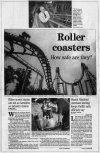
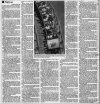
I found the origination of the lift hill photo I recently posted. It's from the Daily Press Sept., 1996 about roller coaster safety. To me, it looks like a PR generated "story" that was trying to mask the DF "issues".
 

Attachments

  • Daily_Press_Sun__Sep_22__1996_.jpg
    Daily_Press_Sun__Sep_22__1996_.jpg
    3.2 MB · Views: 5
  • Daily_Press_Sun__Sep_22__1996_ (1).jpg
    Daily_Press_Sun__Sep_22__1996_ (1).jpg
    1.2 MB · Views: 5
  • Daily_Press_Sun__Sep_22__1996_ (2).jpg
    Daily_Press_Sun__Sep_22__1996_ (2).jpg
    3.5 MB · Views: 5
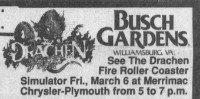
In looking at old newspapers, I came across this drop in a car dealer ad. It was the only time I found any mention. It appeared before DF opened. Anyone have a clue what it was?
My guess: there was a (by modern standards) very crude CGI video of DF which I can't currently find, but seem to remember seeing a long time ago. They probably put that on VHS, brought a VCR to the dealership, and played the tape on a TV there for a couple of hours.
 
Honestly, I would have ridden my bike 20 miles each way to watch a roller coaster “computer video” in the early 90s.

And I remember those solid wood TV cabinets too. They were still easily found in the 70s and 80s... now where did I leave my teeth?
 
So I was discussing this ride with my dad the other day ago, and he firmly believes the reason the ride failed was that the soil was not compacted properly and thus parts of the ride sank too much which in turn knocked the track out of alignment.

However, what I can gather from here is that the ground had little to nothing to do with the problems this ride faced; it was pretty much doomed when Arrow took over a B&M project since Arrow didn't have the engineering prowess to make the B&M ride elements work there way they're supposed to.

What I'm left wondering is it the ground actually did have anything to do with it, and where did that story come from otherwise?
 
As the ride was SBNO, all sorts of crazy rumors were likely afoot.

I've personally never heard anything about any sort of foundation issue with Drachen Fire.
 
Consider Donating to Hide This Ad