I'm an EV owner. Here are some detailed thoughts, which may echo and expand on points made above...
MY SITUATION
I am hedging on energy technologies right now, with one EV and one hybrid in the garage. The gas car is seeing little use these days. Charging the EV in my garage during off-peak hours, leveraging variable power pricing from the local utility, I can drive 300 miles for about $9 in energy cost. Most cars would be lucky to go 60 miles for that money, given the current price of gas. My hybrid sedan probably goes 80 miles on that, or a bit farther if my wife is driving instead of me. I'm as eager for gas prices to drop as anyone else, but it'll never beat 3 cents per mile in anything resembling a normal passenger car. This is an inherent advantage of my EV when selecting between cars for a road trip. And there is plenty of "headroom" in case electric rates go up (I might pay $10 now instead of $9) or gas prices drop. I want to leverage that advantage as much as I can.
So I definitely want to take my EV on road trips to, for example, BGW.
ON CHARGING
I can drive a max of 300 miles on a warm day without stopping to charge. This will get me from the Philly suburbs to Williamsburg this summer with a bit of range to spare, again for $9. But certainly not round trip. I need to charge up for the trip home.
Depending on where, when, and how I charge, it might cost me 4x my original $9, or possibly more if I'm foolish, to get home again. Or it might cost me nothing. It might take hours to charge, or it might seem instantaneous to me. I might have to go substantially out of my way to find a charger, or I might find a charger within 100 yards of my destination, which is even more convenient than a gas station. So... what's the best way to proceed? Fast, cheap, and easy are obviously my key basic variables.
OPTIONS
High speed DC charging is one increasingly visible option along the highway. The cost of high speed DC charging is, by design, a much closer approach to "normal" gas prices than charging at home. It is still cheaper than gas, but at present it also takes more time than gassing up a conventional or hybrid car, and at present there are far fewer high speed DC chargers than ubiquitous gas stations. Again, I have to ask myself how much more time, money, and inconvenience I want to incur to
get home than it took to
leave home. (This whole charger situation is getting better over time, but slowly.)
I don't mind some mild inconvenience, given that I almost never spend any time or money at gas pumps anymore. That's more than enough banked, in both time and money, to spend for occasional EV charging on the road. So I
could just go to a DC fast charger, after looking up their locations on any of a variety of apps (one of which is conveniently built into my EV). Still, the cheaper, faster, and easier it all is, the more of my EV advantage I can preserve.
That's where destination charging (i.e., charging at your immediate point of arrival, like an amusement park) comes in. It is extremely attractive to make charging
free, seemingly-instant, and effortless, right at the point of arrival. And that's exactly what it is, if charging happens in the park's own lot while I am doing something else for hours anyway. It's the equivalent of free gasoline, delivered at a (range-equivalent) rate of perhaps a gallon per hour, directly into your car, all day long. That prospect gets my attention. And it works well for the destination, too, if it costs them relatively little per customer to provide it over the long term. I, and the growing number of people like me, get our heads turned by this perk. To us, it's major.
BGW ETC.
I'm not really aware of how Sea World or Six Flags handle any of this, so the following notes are starting from zero on that front.
Location
If there is an automatic upcharge to park in a single lot where the chargers are, then inevitably the park sets itself up for perpetual complaints. It likely will be commonplace for EV owners to pay extra for a premium lot
only to secure charger access, just to find that all chargers are already occupied (presumably all day btw), or that some are out of service, making it impossible to enjoy the only extra perk they actually were seeking in the first place. This will be a headache for everyone.
I really don't think it's at all wise to charge on a
per-lot basis for charger access. I think the fact that demand inevitably
will sometimes outpace supply is an argument for putting the chargers in multiple lots, or otherwise in one standard-price lot as a starting point. If chargers are then inaccessible or broken, then the charging service remains purely an extra enticement to EV drivers, which happens to be unavailable today. Them's the breaks. That's no different from the deal at shopping centers, museums, etc. today.
Pricing structure
I can see how the park might want to charge a bit at the point of service, literally at the charger, just to offset the build-out and operating costs. This isn't at all difficult for a business to do. But I'm not a huge fan of this idea. Even initially modest upcharges seem to historically be easy targets for price increases whenever parks go looking for revenue boosts. There is also the issue of charging people extra money for leaving their cars connected to the charger once their car finishes charging, which is considered rude (and often does incur extra fees at high speed chargers), but which also is probably inevitable when you are at the other end of BGW and your app notifies you that the car is topped off. Nobody should be expected to cross the park and trudge out to the lot to move their car halfway through the day; it just isn't a practical expectation. The social standard for remaining parked at the charger after charging completes would have to be different. Presumably this happens at Sea World, Six Flags, etc., so I don't know what if anything they do about it. Reactions from other EV drivers may be the bigger worry than any park policy, honestly.
Another objection to pricing per kW-h at the charger is that it's a bad look when a ton of hotels, shopping centers, restaurants, and other places provide this capability for free. Maybe it's different if the park is building out dozens of chargers instead of only two or four. But again, the park is getting over 7,500 cars per peak day in theory, most of them parking for most or all of the day, vs. a small fraction of that (vehicles x hours) elsewhere. So the cost per guest as a perk is kept low.
Charger rating
There are three levels of EV charging, categorized by levels 1-3. By level, in the USA:
- This is like plugging a lamp into a 110V outlet. In fact that's pretty much exactly what it is. Charging your car this way takes days. You might get 2-4 miles of driving range per HOUR of charging. Pretty useless most of the time, unless all other options are unavailable.
- Jump the voltage to 240V and up to 50+ amps, depending on how much the EV can accept via AC current. You can add 20+ miles of range per hour this way, depending on EV. Not massively expensive to install at scale when compared with (3) below. Very suitable for a place where you will park for hours at a time, like a home garage or amusement park.
- High speed DC charging. You can't get this at home. 400-800V, 100+ amps per station. Adds hundreds of miles of range in a couple-dozen minutes. Installation costs add up quickly, can cost an absolute ton to build out due to both hardware and power supply needs.
IMO, level 2 is the only 360-degree reasonable option at a place like BGW. That's a good thing, given that it's not a financial back breaker.
Solar?
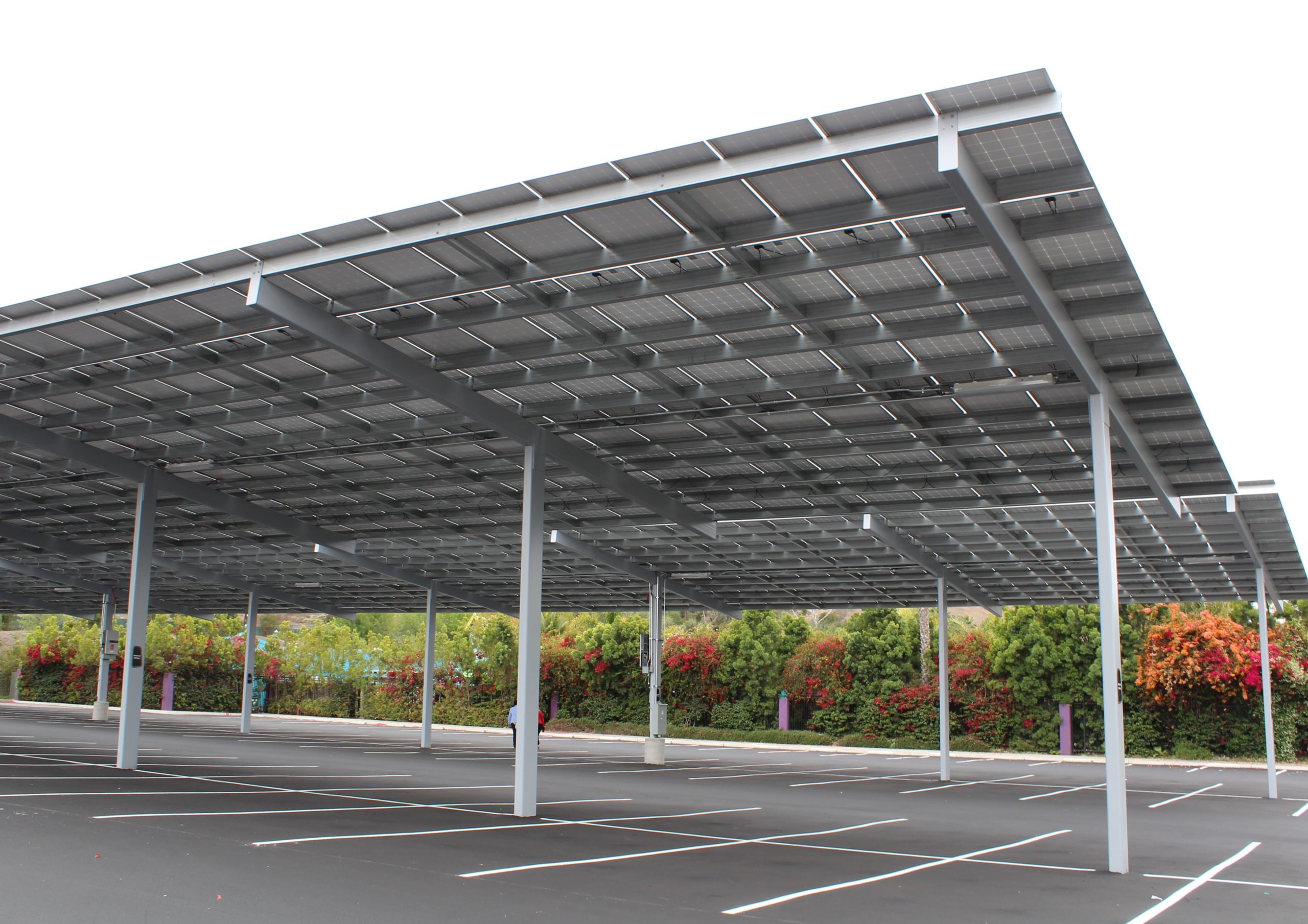
Better than no solar, but I don't dream of self-sustaining solar powered EV chargers in parking lots unless the owner can secure a deal to feed power back onto the grid for credit against the rest of the owner's electrical consumption. Then the grid itself is a pseudo-battery, just as with many residential systems, and the solar is financially productive almost every day once installed. Does a solar "roof" over charging stations generate enough power to constantly exceed car charging requirements beneath that roof? No. But over the course of a year, and if it is grid-tied, I can see it being a smart investment. If that keeps EVs cool under cover while charging, then either charge at the point of delivery (see above) or just consider it another modest enticement for EV ownership. We all ultimately benefit from renewable energy usage, after all.
Scale over time
Imagining the 20-year future of any of this leads to easily envisioned problems. EVs are going to be huge presences on the road, despite Tesla's apparent efforts to double down on pointedly crappy build quality, and despite other automakers' apparent efforts to have pointedly crappy access to high speed chargers. Eventually, an EV purchase will no longer be a choice between those two things, and range etc. will continue to improve too. More EVs means more charging, so does that mean destination charging will have to scale in proportion? A sea of destination chargers across an entire BGW parking lot, or anything approaching that, will no longer be the realm of free perks. Something will have to change well before that point, as the notion of EVs being just 1-5% of cars on the road will no longer hold.
To get to that point, the high speed charger networks - even Tesla's chargers, which in some cases are already prohibitively swamped at popular travel times - will need to massively expand. Maybe they will expand into destination parking lots. Or maybe someday there won't be any more need to have car chargers in parking lots, as is the case today with gas stations. But that's many years away, and at that point I'd expect the charging infra to be both higher-speed than current Level 2 and mostly pay-to-use. If BGW and other locales can get 10 years of use from a Level 2 multi-charger installation, perhaps expanding it once along the way, I'm sure that will prove to have been a good use of time & effort.
In the meantime, it's overall a good thing to structurally encourage EV adoption for most of the next decade,
specifically at places like BGW.