
Project 2022: Pantheon
- Thread starter Shane
- Start date
You are using an out of date browser. It may not display this or other websites correctly.
You should upgrade or use an alternative browser.
You should upgrade or use an alternative browser.
Register or Login to Hide This Ad for Free!
- Status
- Not open for further replies.

It was likely part of the site plan submitted to JCC. I don't think Zachary and Co. ever got/shared the most recent site plans that were submitted to the county (though they got their hands on more comprehensive plans for the attraction itself), and I don't believe the retention pond was shown on the initial submition (at least from the contours I've seen). It likely was added in response from the county, or an internal change of plans.Looks like it must be for a retention pond now, but we're there any permits needed to dig it? I'm surprised such a landscape plan would have passed by unnoticed.


That was a sediment basin. A sediment basin is temporary, but is typically converted into more of a permanent drainage feature (retention or detention pond) once the project is nearing completion. They're meant to catch any runoff from exposed soil during construction so that it doesn't enter streams and rivers.I'm wondering if it's a duplication of the "spillway" on the Festhaus Park side (can't think of the current term) that's shown on this plan .
You do bring up a good point though in the fact that the "pit" that were seeing is purely temporary, and could be filled in towards the end. In that case, the grading/drainage plans and final contours wouldn't reflect the basin, and it would rather be on the Initial Erosion & Sediment Control (E&S) plan. Honestly this might be the most realistic scenario because, as I believe @warfelg has mentioned before, the Rhine technically serves as BGW's permanent retention pond for the entire property.

They actually expanded the fields over there so that it goes back across the pipeline and behind Circus Sinestro. I can't really see how far so it's hard to say how much room they have.I have heard that where they have been moved there is not actually enough space.

That was a sediment basin. A sediment basin is temporary, but is typically converted into more of a permanent drainage feature (retention or detention pond) once the project is nearing completion. They're meant to catch any runoff from exposed soil during construction so that it doesn't enter streams and rivers...
Honestly this might be the most realistic scenario because, as I believe @warfelg has mentioned before, the Rhine technically serves as BGW's permanent retention pond for the entire property.
If that's the case then wouldn't there not have been as much environmental concerns surrounding the removal of vegetation?
I thought the deal was that the park has to jump through so many hoops because the Rhine can actually flow into the James meaning, though highly unlikely, sediment from the park can make it outside of the lake.
Someone else who is more knowledgeable in the matter should correct me if I'm wrong here, but I believe they are mostly concerned with adding impervious area (footers in this case) within the Resource Protection Area (RPA) buffer, which I believe is a US Army Corps of Engineers (USACE) provision. I'm not quite sure what mitigation they are required to provide because of the impacts, but a permanent retention pond certainly could be part of the agreement. I know they were able to bypass most of the issues with Verbolten, since they reused most of the existing BBW footers within the RPA buffer. I'll go back to the RPA buffer waiver permit to see if I can find any of the requirements for MMXX.If that's the case then wouldn't there not have been as much environmental concerns surrounding the removal of vegetation?
I thought the deal was that the park has to jump through so many hoops because the Rhine can actually flow into the James meaning, though highly unlikely, sediment from the park can make it outside of the lake.
Yes about the RPA buffer. Sorry, forgot to acknowledge that part of your question before ?But wouldn't the whole need for the RPA buffer be because the Rhine is actually a partially dammed creek that could flow into the James, otherwise the park could do whatever it wanted on its own land?
Edit: They still couldn't do whatever they wanted on their own land. They would still need to follow JCC, DEQ, and EPA regulations on water quality, because their runoff would eventually flow to some body of water.
My point exactly - if the Rhine was a permanent retention pond then individual changes of landscape/construction and the resulting erosion wouldn't matter because the water does but not leave the Rhine.
However, that's obviously not quite the case.
** This is only in reference to the environmental impact dealing with the RPA buffer and Rhine - obviously if the park wanted to make major changes such as this project there are considerations for building codes, community support, etc.
However, that's obviously not quite the case.
** This is only in reference to the environmental impact dealing with the RPA buffer and Rhine - obviously if the park wanted to make major changes such as this project there are considerations for building codes, community support, etc.
While I'm certainly no expert, the last RPA I've seen was in the front page article about the project. I believe the RPA shows the footers outside of the buffer area. There's a second land use plan that shows some distinct contours in that area. What they are, I've no clue but I'm sure someone does.


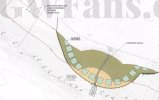

So actually all of the footers shown in that first image @GrandpaD are in the RPA, which is why you don't see any others shown (they only wanted to show what was necessary for the permit at the time). There are two red lines shown on that map, one is a 50' offset from the RPA boundary, and the other is the 100'. They use the different shading to indicate areas within the 50' buffer (seaward), and within the 100' buffer (landward).
Lol, told you I wasn't up on this but willing to learn. Hopefully the refresher of these (unless there are newer ones) might shed some light on the ground transformation.

So when we getting a actual announcment. Where we can see what the colors and stuff are going to be. Or are we just gonna have to wait for track to show up?
@basseyfish we know the color palette (see previous posts) but we do not know the colors of individual components yet. We likely won't know this until tracks etc show up. As more components arrive, we can narrow down the potential colors of other components.
The word on the street is we'll have official announcements regarding this project at the end of July.. but take that with a grain of salt.
The word on the street is we'll have official announcements regarding this project at the end of July.. but take that with a grain of salt.


Basically an Italian guy singing what English sounds like to those who are not familiar with our wonderful language. Fits in that sense that even BGW doesn't fully emulate international cultures so we all get the wrong impression of things anyways.
It's also a really catchy tune, so give it a listen or 12.
It's also a really catchy tune, so give it a listen or 12.
It's like someone woke up from a fever dream and decided to turn it into a video.
- Status
- Not open for further replies.
Share:
Consider Donating to Hide This Ad