

Project 2019: Finnegan's Flyer (S&S Screamin' Swing)
- Thread starter Adam
- Start date
You are using an out of date browser. It may not display this or other websites correctly.
You should upgrade or use an alternative browser.
You should upgrade or use an alternative browser.
Register or Login to Hide This Ad for Free!
- Status
- Not open for further replies.


EDITED
<comment in question>
I am not going to be gentle here. If any of my Scenic Art students had turned that in as a project we would have had a few words.
<Inserted Edit>
So I went back and re-read my post and thought, "well that needs some explanation!"
Why do I feel it is worth a failing grade. Well there are several issues.
In their defense, It could have been that they were very rushed and could only do but so much faux finish work, and to be fair to do it right stone work takes several passes.
So Zimmy, what would you have done?
I am so glad you asked!
I would not have used a Faux finish. I would have painted the supports green fading into sky blue or just green. I would then on site erected a metal frame up about 10 to 20 feet about a 1 foot away and surrounding the supports. On this frame I would have applied 3d faux stone panels that closely matched the bridge.
Why a foot away you ask? To allow for shifting and movement. The panels might crack if attached directly to the supports.
<comment in question>
I am not going to be gentle here. If any of my Scenic Art students had turned that in as a project we would have had a few words.
<Inserted Edit>
So I went back and re-read my post and thought, "well that needs some explanation!"
Why do I feel it is worth a failing grade. Well there are several issues.
- Design - This one is huge.
- Context - At least as I was taught and as I teach, when one is designing scenery, and for all intents and purposes that is what they paint job is, you have to consider a bigger picture. It is very easy to take a piece from a set and design it for it's own sake. In this regard the paint job could stand on it's own. (more on this later.) HOWEVER this leads to continuity issues. In this case they are big, bold, and i your face.
- Texture - The bridge and the general area have existed since the beginning of the park. The hamlet has had a face lift but the design principal has not changed, 3d texturing and very realistic stone work. Clearly the ride lacks both.
- The bridge is almost part of this ride now given proximity. The juxtaposition is horrifying. Not just the change in color, because you might make that work, but the level of detail and again, the texture
- If this thing stood on its own, maybe the appearance could be acceptable. But it doesn't and it is largely due to the paint.
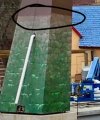
- Paint - There are several ways to paint Faux stone, I outline one below. I know at least 3 different ways to paint marble for example. (I am good at none of them) As I look at the closeup of the paint without anything around it I get a better feel for what was being done. (Thanks to @Alf33 for the excellent, albeit sideways image, it has been a terrific help)
- I put this image on my projector screen and stood back about 15 feet as one does when judging scenic art. This is what I noticed
- I kind of works in a certain context. Kids theater. It has a certain cartoon quality and simplistic style indicative to that type of show.
- The lowest black level seems to have a bit more detail.
- The basic stone is a very simple blend, it appears to be a scumble. I count maybe 3 colors in the blend.
- The gaps between the stone feel to large partially giving them the cartoon look.
- The highlight looks like spray paint and is not very accurate, again giving into the cartoonish appearance.
- The fade into brown makes it look incomplete. I am not certain what they were trying for here.
- Some of the lower moss work looks nice, it is the brighter green color the higher you go the sloppier it gets. This is one of the key features that gives it a better at the bottom feel.
- The general moss is just sloppy, looks like rattle can and masking. I am not a fan. Frankly it is the biggest feature (bug?) that creates the discontinuity with the bridge.
- Scaling. There is none. The general block size does not change witch is first of all not realistic and second makes the braces appear shorter than they actually are. If the stone progressively got smaller, the vanishing point would be farther out in space making them appear longer. The reason this perspective is so jarring lies with the shape of the supports just with their taper they foreshorten the image. So unchanging stone size is in-congruent and makes it look shorter and weird. The, albeit bad, fade into brown also creates a weird forshortinging.
- If this were on a Broadway flat, regular and with right angles and no fade to brown. (why brown??) It would be fine as tormentor upstage of the proscenium arch. Hell It might be okay as a ground row if only 4 feet high. But this is on stage, and needs to been seen for 20 or 30 feet away. It is not okay for something a person get very close to.
In their defense, It could have been that they were very rushed and could only do but so much faux finish work, and to be fair to do it right stone work takes several passes.
- Base scumble, 3 or 4 colors
- some kind of texture blend, 3 or 4 colors (I typically use a sea sponge)
- spattering 3 or 4 colors
- crevice lining 2 or 3 colors blended
- cracks and other details
- highlight and shadow
- Pops of faux moss or other ditrious
- protective coats
So Zimmy, what would you have done?
I am so glad you asked!
I would not have used a Faux finish. I would have painted the supports green fading into sky blue or just green. I would then on site erected a metal frame up about 10 to 20 feet about a 1 foot away and surrounding the supports. On this frame I would have applied 3d faux stone panels that closely matched the bridge.
Why a foot away you ask? To allow for shifting and movement. The panels might crack if attached directly to the supports.
Last edited:

Looks like we need a little touch up between the Rock and the Hard place.



By the looks of construction, I think they really are shootin for that April opening. Also, am I the only one who really thinks to doesn't look bad? At least they attempted to theme it at all.

The point of "World's Most Beautiful Theme Park" isn't to attempt theming. It is to excel in it.
Just the fact that the paintings don't even line up from side to side is a slap in the face. Whichever person they sent out there to paint that deserves a stern talking to.
Just the fact that the paintings don't even line up from side to side is a slap in the face. Whichever person they sent out there to paint that deserves a stern talking to.

I’m so happy this ride is being built here. Solely because I’ve wanted a Screamin Swing in VA since I rode Barnstormer at Dollywood such a fun ride.

I really think we are looking at early May. There is still a significant amount of work to be done to the surrounding area that you can see from the train. It really looks like they have a ways go. They aren't even done with the platform. I think they wanted to get the supports up because it creates excitement by being able to see them going up.By the looks of construction, I think they really are shootin for that April opening. Also, am I the only one who really thinks to doesn't look bad? At least they attempted to theme it at all.
They still need to get the queue structure finished, the control booth, the entrance, rebuild the river below, and then get training and testing complete.

Not to mention the trees they’ll have to plant at the water’s edge to soften up the stark corners and front face of that massive platform.
Right? RIGHT?!?
Right? RIGHT?!?
Kevin said today at C4K that it would be May, and that they should know more about a date in the next 7-10 days.

I would imagine they want to get the heavy lifts done soon so the can get the crane out of there and start the process of restoring the water area. As far as the painting here is my theory...they were laying on the side and from where the person was painting they could only see the side and just guessed about where the rockwork stopped on the top. Guess they were either too lazy to get a ladder or possibly the companies insurance rider prohibited a non employee of doing such at their location in Utah.
As far as the painting here is my theory...they were laying on the side and from where the person was painting they could only see the side and just guessed about where the rockwork stopped on the top. Guess they were either too lazy to get a ladder or possibly the companies insurance rider prohibited a non employee of doing such at their location in Utah.
I agree. I think this is a pretty likely explanation. I think that they will definitely be touching it and doing more work one they start theming.
Something else I was thinking, they should have two queue lines, one for each direction because I am sure people will want to ride looking both directions and some will like one directions view better than others.I know the ride is exactly the same either way but it would be nice for the views.
The queue line at cedar point for their screaming swing splits into two rows with color dots for each side.
- Status
- Not open for further replies.
Share:
Consider Donating to Hide This Ad