I've been thinking about the question of parks leaving the chain quite a bit since the conference call and have been kicking around thoughts in a couple different groups. Some of my thoughts are very similar to what was mentioned in the original post, while some differ quite a bit. Here's where I'm at with my own list...
First off, let's list out the parks that are 100% safe. For me, that list includes the following twelve theme parks: Canada's Wonderland, Carowinds, Cedar Point, Fiesta Texas, Great Adventure, Great America (IL...CA's fate is sealed), Kings Dominion, Kings Island, Magic Mountain, New England, Over Georgia, and Over Texas, Additionally, all of the waterparks associated with those properties are safe, plus Castaway Bay and White Water, which are both near but not directly adjacent to their theme park. That accounts for fourteen of the thirty-five properties as they are listed on the current Six Flags website (I'm omitting Sawmill Creek Resort due to lack of knowledge regarding it). All of these are among the chain's larger properties and the theme parks are almost certainly within the core fifteen parks the company has referenced in the past. All of them also received notable capital investment either shortly before, during, or shortly after the merger, and most have been cited as having significant growth potential. I see pretty much no argument as to why any of these are at risk.
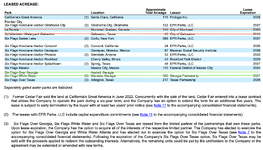
Secondly, there's the group that consists of the six EPR Properties: Darien Lake, Frontier City, and the Hurricane Harbors in Concord, Oklahoma City, Phoenix, and Splashtown. I believe these are all covered under a single management contract, and as such I see it as a bit of an all or nothing option for the chain. Historically, management contracts were something legacy Six Flags was much more open to than legacy Cedar Fair, and as such I'm leaning toward terminating the contract to use the resources spent on these properties at the core parks. However, if the terms are particularly favorable (especially in comparison to the penalty of cancellation), it's not impossible to imagine Six Flags hanging on to the parks. I do not expect any would represent a significant threat to the market share of Six Flags were they in a competitor's hands, nor do I believe they really contribute to feeding the attendance at any of the core properties.
With those out of the way, let's look at the other fourteen properties on an individual basis. I'm going to classify these as high risk (would be surprised to see still in the chain in three to five years), medium risk (wouldn't be surprised if it left, but wouldn't be surprised if it stayed), and low risk (expect it to stay, but could see it leaving under certain circumstances).
High Risk:
Hurricane Harbor Rockford: Ownership of this park has never made sense to me, even within the legacy Six Flags chain. It is a standalone water park located a good 1.5-2 hour drive from Chicago (for reference, SFGAm is 45-60 minutes), and while I haven't visited the park personally, it looks to be small to medium in size and lacking anything notable to drive visitation from outside of a very local audience. As the current contract expires in 2029 it might not be worth seeking an early termination, but I'd be very surprised to see this one renewed.
Michigan's Adventure: When Six Flags talked about "mini cash cow" parks, this one immediately jumped to mind. It has a really high profit margin and made a ton of sense for legacy Cedar Fair to operate, as they could get a fairly consistent amount of annual revenue with minimal investment (in the past decade, the only attractions capital has been redoing the kids areas for both the amusement and waterparks). However, the magnitude of that revenue is tiny compared to pretty much any other park in the chain. Now that Six Flags owns both Cedar Point and Great America, the market share that's exclusive to Michigan's Adventure is probably quite small, so it's probably not worth the resources to keep this one going for the amount that it brings in. I would not be at all surprised if it's announced that 2026 is the final year for this park.
Schlitterbahn Galveston: I see this being a very obvious sell. It's located in a tourist area, making it very lucrative for another operator to pick up, and it is so far removed from any other Six Flags property (Splashtown is over an hour away and you're looking at 3.5 hours minimum to a theme park) that cross traffic between this and other properties is pretty much negligible.
St. Louis: They say they're not at risk, but it's hard to buy into that. While the park was invested in pretty consistently by legacy Six Flags, they haven't received something I'd consider a major investment since Justice League opened a decade ago. St. Louis is also not a growing city at the moment, which limits the growth potential of this park without some pretty huge capital expenditures. If something saves this park, it's probably the low land value of the property on which it operates, but if resources become tight for the company shuttering it might still make sense even without a sale.
Medium Risk:
Discovery Kingdom: Six Flags talked a bit about parks that could fall from core to non-core depending on how they respond, and to me SFDK is one that falls into that area perfectly. We know CGA is closing most likely within the next two years, so I believe this park's future will be strongly tied to how well it is able to pick up that customer base. Six Flags is trying to shift the CGA regulars over to this park by moving all of the event assets and most of the full time staff, and if the crowds follow I see a bright future for this park. If attendance and revenue don't increase, however, Six Flags could easily sell this one off with minimal risk of competition with any of their other properties.
Hurricane Harbor Oaxtepec: Quite frankly, I know next to nothing about this property other than the fact that it's about an hour from Six Flags Mexico and it was a SBNO park Six Flags purchased and revived. Synergy with SFM and the value of a sale are really what will decide the future of this one.
La Ronde: The safest of the managed properties in my eyes. If Six Flags dumps this park, it's because they want to get out of the management model and fully own all of their properties, which is absolutely a possibility. Barring that, I don't see it being cut as I've heard it does extremely good business despite its short operating season. It has been a bit starved for investment, however.
Schlitterbahn New Braunfels: I pretty strongly disagree with the initial assessment of this being a definite goner. This place is an icon of the region even more so than Fiesta Texas, and consists of multiple waterparks as well as an onsite resort property. It is also in a climate that allows for operation from March to October, something few other waterparks can do, and it is sufficiently close to San Antonio to create a symbiotic relationship with SFFT. If this were a standard Hurricane Harbor it'd be easy to see it getting cut loose, but I think outright closing it would harm Six Flags significantly in the region and I'm sure they'd much rather see it in their hands than in those of a competitor. If they decide to let it go, it is probably because they simply have no interest in running standalone water parks going forward, and I would be shocked were this to be cut while others remained.
Valleyfair: This park struggles with justifying investment, indicating there isn't a whole lot of potential growth in the market. Indeed, the waterpark overhaul for next year is the first attraction-related capital the park has received since 2018, and that was just the installment of a flat ride. I very much feel the future of this park is going to be tied to the performance of that project...if it meets or exceeds expectations, Valleyfair will remain, but if it underperforms, the park is going out on the market.
Worlds of Fun: Things looked promising when the park got Zambezi Zinger, their first new roller coaster since Prowler and something that looked like the start of a major expansion, but after that everything went silent. Did that coaster underperform? Did the merger push stuff back? Was something supposed to happen to Timber Wolf next that got quietly cancelled? I don't really have a good read on this park, but the fact that it didn't even get a survey when Mattel just signed a deal to build one of their parks nearby is a bit concerning. I don't think WOF is on the chopping block yet, but I very much see this as one that probably is underperforming at the moment and could wind up there if investments don't change the numbers by a satisfactory amount.
Low Risk:
Dorney Park: Gotta be honest, calling this one "critically endangered" is pretty wild to me. No, it isn't the biggest park out there, but by every account I've heard the park is thriving. Clearly they do enough business that they were worthy of a B&M dive, and while the exact cost hasn't been released, I imagine such a coaster wasn't a cheap investment (I would guess it was in the $15 million ballpark). The survey for this park had quite a few attractions currently found at CGA and SFA, so I suspect we're going to see this property inundated with salvaged attractions over the next few years. Maybe if that doesn't move the needle the position of the park will be reevaluated, but at least until SFGAdv can be built back up it's needed to prevent losing guests to competitors in one of the more competitive theme park markets in the country. I also feel the idea of one park hurting the other is misguided, and view the combo of Dorney and SFGAdv similar to the way I view the duo of Knott's and SFMM. Both parks are located in the same general geographic area, but both have unique identities and different focuses allowing them to coexist with each other. While there is some market overlap, each also has it's own exclusive share of the market, thus closing one down is not going to automatically make the other more successful. Now, if Dorney actually sits on super valuable land, then it might be in trouble, and I'm not sure what the going price is in that part of the country. However, barring that, I see no reason to worry about the future of this park.
Great Escape: This is a very difficult one to judge because it's in a pretty unique situation. If it were just an amusement park in the middle of a suburban area near a big city, it probably would be toast for land values. However, it is attached to a waterpark resort and is located out in a regional tourism center, meaning the park draws a significantly higher proportion of day visitors than many of the parks in the chain. It's not a park with a ton of growth potential, but it does feel like the park that has a lot more value than somewhere like Michigan's Adventure, plus it's close enough to SFNE and different enough from it that the two function similarly to the partner pairings mentioned above. I wouldn't say there's no chance of this being sold, but I don't think it's one of the first Six Flags would be looking to cut.
Knott's Berry Farm: This is one I expect many to disagree on, but I think my perspective having it as my home Six Flags probably adds a little insight. Yes, the park makes a ton of money, and being a year round property in the middle of Southern California allows it to draw huge numbers of guests. But the park is unable to handle the crowds that they're currently getting. Parking hits capacity regularly on weekends during peak season, and there are an increasing number of days each year where the park needs to close its gates because they've simply maxed out how many guests can be accommodated. The property is landlocked, limiting the potential for physical expansion, and the city is very challenging to work with when it comes to new additions. The reputation of the park has also diminished in recent years, with many seeing it as the park for those who can't afford Disneyland, and they've started to have a staffing issue as Disney and Universal are more lucrative employers pulling from the same pool of candidates. The reason I have this park as low risk rather than 100% safe is because the park needs a massive amount of infrastructure investment in things that won't bring a return in order to really grow much beyond what it is currently generating, and I'm not certain that is an expense Six Flags would be willing to take on. It is absolutely the safest of the "not safe" parks, but particularly if another operator made Six Flags a really sweet deal for this property I could see them opting to sell rather than do what would be necessary to benefit from the addition of something like a giga coaster.
Mexico: This one is 100% safe unless Six Flags decides they want to completely exit from Mexico to focus on their operation in the much wealthier USA and Canada. The park is a year round property with little competition in the middle of the most populous metro area on the continent, and as a result it performs extremely well, but in terms of absolute value it doesn't bring in the revenue of the larger parks and it has virtually no crossover with any other park in the chain (except the nearby Hurricane Harbor). The Mexico City government is also notoriously difficult to work with, making it quite challenging to install sizable new attractions at this location.